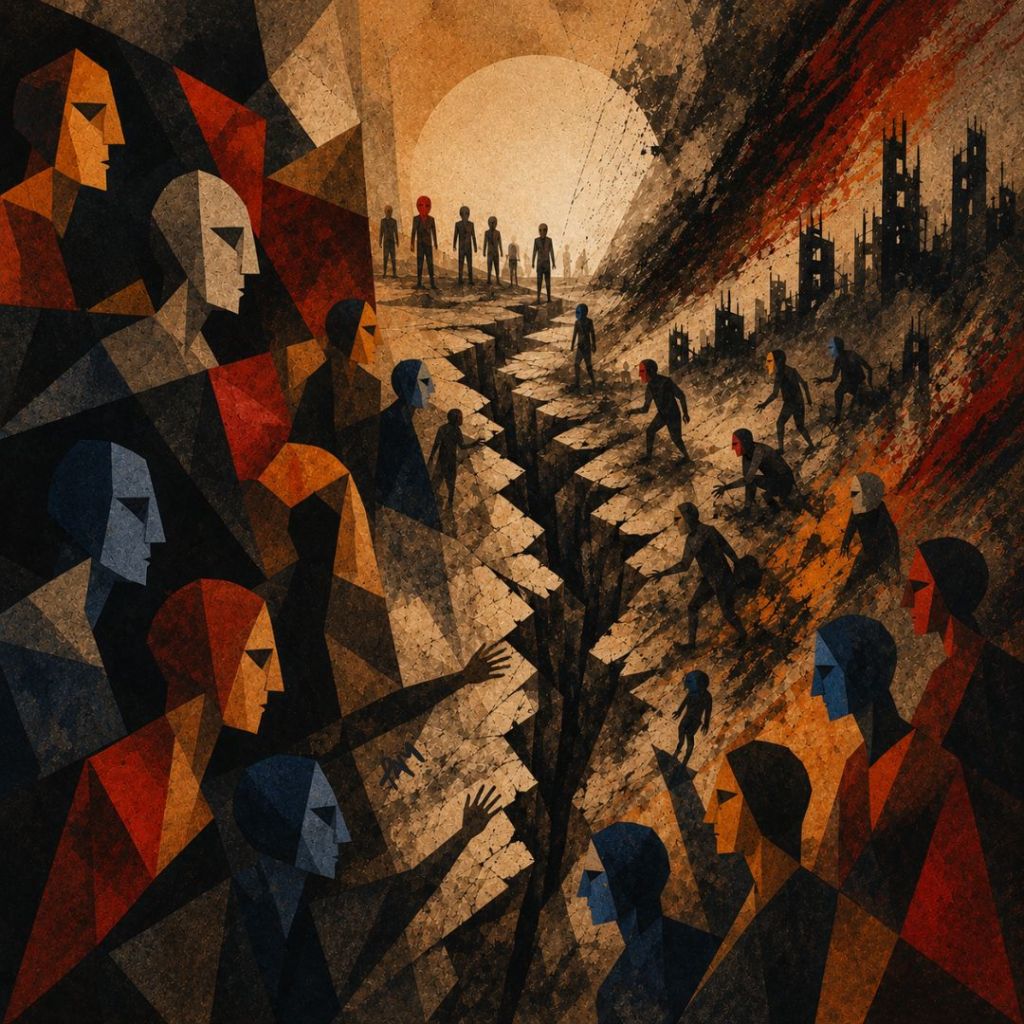
A dramatic, expressionist oil painting rendered in a dark, textured
style, depicting a tense and claustrophobic scene in a smoke-choked
planners' room.
As
a geographer and sociologist, I have spent years studying regional
planning and policy development and implementation, from evaluating
local refugee policies to observing the strategizing phases of
intercultural laws in Mexico City. What you learn very quickly in this
field is that the concept of a flawless, omnipotent “Masterplan” is a
complete myth.
Take
the territorial zoning of a single street. You cannot simply draw a
line on a map and declare it transformed. A street is already a living
organism with its own material reality and history. Before a single
policy changes, planners have to study the pedestrian frequency. They
have to count every building, assess how it is currently used, identify
the most frequented spaces, talk with pedestrians and residents, and
engage in endless, repetitive talks with local “stakeholders.” Then come
the whitepapers, the budgeting constraints, the implementation plans,
and the consecutive evaluations. And just when the plan is set, a new
administration comes in, or the material conditions change, and the
entire process must iterate and adapt. And let’s not forget, in reality
there are also planning cultures, and historical periods and visions of
planning that influence this process, too.
If it takes this much bureaucratic friction, iteration, and socialization to change the trajectory of one single street,
why do so many geopolitical analysts assume the most heavily resourced
empire in human history operates through the incoherent decisions of a
group of politicians? Or likewise assume that it operates via a
flawless, omniscient Masterplan hatched in a single smoke-filled room?
When
we look at global geopolitics today—specifically the U.S.-led imperial
core’s actions against countries like China, Russia, or Iran—much of the
alternative media space suffers from a cartoonish misunderstanding of
how complex institutions and organizations work. If a U.S. military
operation fails to achieve its maximalist goal, commentators immediately
declare the empire “defeated” or incompetent.
But
empires, like city governments, do not surrender when a policy fails.
They evaluate, they consult their stakeholders, they conduct studies,
and they adapt. To think that there is a grand masterplan or likewise to
insist that there is no plan at all, are assumptions with political
consequences. I want to explain why, from the perspective of someone who
has spent years studying planning.
The
conventional understanding of planning relies on a neat, conceptual
division between setting objectives and executing them. While there is a
kernel of truth here, this framework has almost no relationship to how
massive, sprawling institutions actually operate.
In
the popular imagination, a “plan” is a static blueprint—authored by a
single mastermind or a small, shadowy cabal—that dictates a flawless,
linear sequence of actions leading directly to a predetermined outcome.
Because of this myth, when reality fails to match the cinematic
image—when we instead see a mess of competing documents, multiple
authors, iterative revisions, and reactive adaptations to changing
conditions—outside observers immediately conclude that there is no plan at all. But this messy, iterative friction is exactly what planning looks like in any complex organization.
Let’s
break down the actual sociological dimensions of this process and map
them directly onto the imperial strategic architecture we observe today:
A plan is never a single, static document. It is a hierarchy and a network of documents. In
fact, it is far more accurate to discard the noun altogether: rather
than looking for a finalized “plan,” we must observe the continuous process of planning.
This process is distributed across multiple institutions and
organizations—public, private, semi-public, and informal. No single
author controls every piece. Instead, coherence emerges from shared
professional norms, common data sets, legal requirements, and
institutional memory.
Consider
a standard regional development plan. It does not live in one binder;
it exists across multiple distinct phases and frameworks:
Strategic Frameworks: Setting the overarching vision and goals (e.g., “increase regional economic competitiveness by 20% over 15 years”).
Spatial Development Plans: Translating those abstract goals into physical realities like land use, infrastructure corridors, and zoning designations.
Sectoral Plans:
Detailed blueprints for transportation, energy, housing, and
environmental protection, each authored by specialized agencies with
their own distinct expertise and constituencies.
Implementation Programs:
The gritty realities of budgets, timelines, responsible agencies, and
performance indicators for the next 3-to-5-year cycle (or for however
long the time horizon has been calculated.)
Evaluation Reports: Assessments that measure progress, identify obstacles, and recommend adjustments.
Furthermore,
planning is almost never a linear, one-off act. Even a finite project,
like the construction of a building, has a long lifecycle embedded in
shifting spatial realities. A building is not dropped into a vacuum; it
is anchored in a physical environment—surrounding infrastructure,
evolving neighborhoods, and broader regional ecosystems—that is
constantly undergoing its own planning processes. The building simply
becomes a node in that larger, ongoing web.
True
planning, therefore, is a continuous, iterative cycle of formulation,
implementation, evaluation, and revision. It contains explicit
mechanisms for adaptation: contingency scenarios, feedback loops, and
periodic review mandates. The fact that a plan changes in response to new conditions is, therefore, a sign that the planning process is actually working. Adapting to friction is simply a planner’s daily bread.
Imagine
the waste management plan of a mid-sized city. It involves the
municipality, the regional authority, the environmental agency, private
contractors, and EU directives. It has short-term implementation
schedules and long-term strategic goals, and it is routinely revised
based on performance data. Now look at how that plan meets reality. When
the city council sets out to pave a new road, it doesn’t just pour
asphalt on day one. It holds three contentious budget meetings because
initial projections fell through three times. It conducts a mandatory
environmental review. A local citizen objects to that review, which
triggers an emergency planning council hearing, which delays the
timeline, which ultimately forces a renegotiation with the private
contractor. You get the picture.
When this happens, no serious person points at the municipality and screams, “Aha! The city is in chaos! They have no plan!” We intuitively understand that navigating this grinding bureaucracy—that adjusting to friction—is
part of the proccess of planning. Yet, when the exact same structural
adaptation occurs at the level of imperial strategy, many will throw up
their hands, point to the friction, and declare that the empire is in
“chaos.”
We
can map the transatlantic strategic architecture regarding weaponized
energy directly onto this mundane planning structure. I know global
energy is a highly contentious topic, so let me preempt a common
strawman right here: no, I am not arguing that the U.S.
or the imperial structure intends to, or is trying to, successfully
provide the world with energy. That is entirely beside the point.
The point is that the management
of these energy flows—specifically their weaponization and
denial—operates as a standard sectoral planning process. It has the
exact same administrative rhythm as our city council. If we look at the
paper trail, the “plan” reveals itself as an ongoing, layered system:
The Strategic Framework: The National Energy Policy (2001),
born from Dick Cheney’s closed-door meetings with energy CEOs, serves
as the foundational text. It sets the overarching, long-term goal: shift
the center of gravity of global energy to the Western Hemisphere and
reduce dependence on “foreign powers that do not always have America’s
interests at heart.”
The Spatial Development Concepts: Reports like Brookings’ “Fueling a New Disorder” (2014) and the CFR’s “America’s Energy Resurgence”
(2013) function as the spatial translators. They take the strategic
goal and map it onto geopolitical scenarios, identifying the
opportunities created by the shale revolution, defining critical
chokepoints and corridors, and outlining the logic of “mutually assured
denial.”
The Sectoral Plans:
Next, military academia and think tanks translate these concepts into
operational mechanics. The Naval Postgraduate School holds seminars on
the “Reverse Oil Weapon” (energy as a domain of naval warfare); the Army
War College publishes “Energy as a Strategic Weapon” (2015) for land-based denial; and CNAS drafts reports on energy as an instrument of great-power competition.
The Implementation Plans: Finally, these concepts hit the real world through budgets, force postures, and legal frameworks. This is NATO’s “Operation Arctic Sentry,” the US Navy’s Maritime Action Plan (MAP), or the SHIPS for America Act (2025).
The Evaluation & Reconvergance Mechanisms:
Summits like Bilderberg, the Munich Security Conference (MSC), or WEF
in Davos serve as the review boards. Agenda items like “Arctic Security”
or “Energy Diversification” are simply the headings under which the
assembled actors assess progress, identify obstacles, and coordinate
necessary adjustments.
A
concrete outcome of this iterative cycle is the policy trajectory
regarding Iran: moving from the JCPOA, to “maximum pressure,” to covert
escalation, to the current MoU negotiations. Each phase learns from the
previous one. The overarching goal remains constant (neutralizing Iran
as a sovereign threat), but the methods adapt continuously to friction.
None of this requires a single author, a single smoke-filled room, or a secret document labeled “The Masterplan.”
What it requires is an institutional ecosystem.
Coherence is achieved through a shared strategic grammar, socialized
across multiple institutions over decades, allowing different actors in
different domains to produce documents that are mutually reinforcing.
Because the people within these institutions share a common set of
structural incentives and a common class position, explicit coordination
is often unnecessary. Their plans align because their institutions are
socially and materially aligned.
Another
interesting point is that different documents within a planning process
have entirely different authors and audiences. A strategic framework is
authored by high-level commissions (like the Cheney task force) for an
audience of political principals and corporate stakeholders. An
operational concept is authored by military-academic researchers (like
the Naval Postgraduate School) for an audience of mid-career officers
and defense planners. An implementation plan is authored by agency staff
for an audience of program managers and budget officials. And so on …
This
differentiation of authorship and audience is evidence of a mature,
institutionally differentiated planning apparatus. The fact that the
Cheney task force did not write the Naval Postgraduate School seminar,
and the Naval Postgraduate School did not write the Bilderberg agenda,
solely reflects how the planning function is distributed across a
network of specialized institutions. Each contributes a piece to a
larger architecture that no single actor fully controls, but which
nevertheless produces coherent strategic outcomes.
Therefore,
a distributed, networked planning apparatus does not signify the
absence of a plan. The entire point of institutionalized planning in
complex systems is that no one needs to be “in charge” in the sense of a
single, commanding mind. The institutions themselves—through their
procedures, their career paths, their funding streams, and their
ideological assumptions over the decades or even centuries—produce coherence without a central planner.
In
urban and regional planning, plans are not simply executed and then
abandoned. They are implemented, monitored, evaluated, and revised in a
continuous cycle. An iterative feedback loop. If we look closely at the
imperial strategic architecture regarding Iran, we can observe this
exact iterative logic functioning:
Iteration 1 (Negotiated Constraint):
The JCPOA (2015) was a plan for managing Iran’s nuclear program through
“diplomatic” containment. It was subsequently evaluated under the Trump
administration, deemed insufficient for broader regional containment,
and discarded.
Iteration 2 (Maximum Pressure):
The strategy revised into economic strangulation. When this was
evaluated and deemed insufficient to produce Iranian capitulation, it
escalated into kinetic action—the assassination of Soleimani and the
covert sabotage of energy infrastructure—leading directly into the
2024–2026 war.
Iteration 3 (Kinetic War & Naval Denial):
The war was evaluated in real-time. The Strait of Hormuz became
actively contested. The naval blockade was established. The “Reverse Oil
Weapon” concept—socialized in the Naval Postgraduate School a decade
earlier—was officially operationalized. While the previous instruments
of Iteration 2 were still being used.
Iteration 4 (Fragmentation & The MoU):
Having failed to achieve total capitulation through military means, the
strategy pivots again. The current MoU represents a fragmentationist
approach—likely modeled after the strategies deployed against Venezuela
or the framework of the so-called Board of Peace. It offers the local
integrationist faction a path to liquidity while extracting almost
irreversible concessions (such as the opening of the Strait of Hormuz
and a nuclear freeze) in exchange for highly revocable promises. The
concessions approach irreversibility because the trap is structural:
signing the agreement binds Iran to a new diplomatic and infrastructural
reality, making any future closure of Hormuz far more politically and
economically costly on the international stage. Furthermore, this
dynamic directly manipulates the balance of power between competing
elite factions inside Iran, dictating who gains leverage and when. While
the specific mechanics of these internal factional struggles and what
this means for the future use of asymmetrical deterrents warrant their
own dedicated analysis, the overarching imperial function at first
glance seems to be to structurally fragment the target state's internal
cohesion.
To
be clear, the ink on this MoU is barely dry, and the geopolitical
situation remains highly fluid. This is, necessarily, just a first
impression of its strategic function. But whether this specific
agreement holds, collapses next month, or mutates into something else
entirely, its structural role remains the same: it is simply the latest
data point in an ongoing iterative feedback loop.
Every
single phase is an iteration, and each iteration learns from the
friction of the previous one. The overarching goal remains constant:
neutralize Iran as a sovereign, independent threat. But the methods
adapt. This is not a “Masterplan” in the cinematic, cartoon sense, nor
is it “chaos” or “no plan.” It is a planning process in the strict sociological sense: complex, multi-phase, multi-author, highly iterative, adaptive, and entirely coherent within its own strategic grammar.
Beyond
iterative feedback loops, professional planning is characterized by its
granular depth: the continuous generation of worst- and best-case
scenarios, strict budgetary frameworks, and rigorous qualitative
analysis among other things. The imperial planning apparatus
demonstrates this level of detail, as well
The Brookings Fueling a New Disorder
paper, for instance, explicitly models multiple scenarios for US-China
energy relations, including the “mutually assured denial” equilibrium.
Similarly, the Path to Persia framework outlines
various instruments of pressure—sanctions, covert action, diplomatic
isolation, energy disruption, and military strikes—as a modular matrix
of options to be combined and sequenced according to situational
friction. The Naval Postgraduate School goes a step further, actively wargaming these variables in their “Energy Defense” seminars to map out second- and third-order effects on global energy markets, alliance management, and adversary behavior.
Crucially,
this planning extends beyond theoretical wargaming into hard fiscal
realities and profound qualitative debates. The budgetary and
operational dimension is codified in structural legislation. The SHIPS for America Act specifies the exact financial incentives and penalties required to rebuild the US maritime fleet, while the Maritime Action Plan dictates the precise percentage of strategic cargo that must be carried on US-built vessels by specific dates.
Meanwhile,
the qualitative dimension of this planning process is vividly captured
by the intellectual tension between figures like Ayşe Zarakol and Niall
Ferguson at the 2026 Bilderberg meeting. Because
such forums operate entirely behind closed doors, we must deduce the
contours of the conversation from its participants. The presence of
these specific historians suggests that the elite debate touched on how
to fundamentally conceptualize the current hegemonic challenge: Are we
reliving 1947, 1914, or the 17th century? This is a purely qualitative,
historical debate, and it is precisely the kind of foundational question
that shapes long-term imperial planning horizons and defines its
underlying planning culture.
And,
goodness gracious, yes, every regional, supra-regional, and even global
institution runs on these exact same mundane processes we have mapped
out so far.
While researching another piece on NATO, I recently came across a document titled the NATO Lessons Learned Handbook
(Third Edition, published in February 2016 by the Joint Analysis and
Lessons Learned Centre with the help of US Navy Reservists). It is
essentially a manual detailing how NATO plans to plan, and how it evaluates its own strategies.
Let
me tell you: you will die of boredom if you try to read it. Its table
of contents alone is a sedative, featuring gripping chapters like
“Gathering Observations,” “Staffing Lessons Identified to Lessons
Learned,” and an annex with a “Lessons Learned Capability Checklist”
that rates organizations on their mindset, leadership, and tools. But
this sheer, unadulterated boredom is the ultimate antidote to the
“Masterplan” myth.
The
handbook explains, with the unblinking seriousness of someone who has
spent decades inside institutions, the grueling gauntlet an observation
must survive to become a lesson. So, bear with me… When you submit an
observation for review, you must first ask yourself: “Is this an objective observation and not just an obvious complaint about something or somebody?” Then: “Is this a problem with the system and not just a simple mistake by somebody?” And then, my personal favorite: “Would you spend your own money to fix this issue? Would you spend your own time fixing this issue?” (Okay then…)
If
the answer to all of these is yes, your observation may proceed to the
next stage of the process. There, it will be rigorously tagged with
metadata (Date, Classification, Releasability, Title, NATO Main
Capability Area). When analyzing a strategic failure, these planners do
not consult a shadowy cabal; they use an HR-style brainstorming
technique called “Five Times Why,” where staff sit around a table and repeatedly ask, “Why has this happened?”
like middle-schoolers doing root-cause analysis. They even have strict
administrative requirements reminding officers to properly tag the
“Submitter” and the “POC” (Point of Contact) on their observation
spreadsheets so the files do not get lost on the local server.
The
“Bunker State” is held together by the exact same soul-crushing
corporate bureaucracy as your local municipal zoning board. The NATO
handbook literally contains a checklist for “Choosing Software Tools”
that asks planners to seriously consider: What are the bandwidth requirements? Is the software easy to use? What report generation capability is needed?
Take,
for example, how this document describes the military’s adaptation to
Improvised Explosive Devices (IEDs). When the imperial military machine
encounters a lethal disruption like an
IED, how does it adapt? Does an omnipotent planner snap their fingers?
No. According to the handbook, the IED community follows a continuous learning cycle:
they generate a report identifying what can be learned, pass it through
multinational working groups to update “Standard Operating Procedures,”
and then—I kid you not—they institutionalize the new procedures into
training and communicate them to current staff “through newsletters and bulletins.”
Newsletters.
The handbook even pauses to remind its readers that audience formatting matters when sharing these lessons: “The
way you present LL [Lessons Learned] information to a general who needs
the information to make a command decision... will need to be different
to the way you present LL information to a corporal who needs the
information to improve his own daily working practices.” One
can almost picture the general and the corporal, each receiving their
appropriately formatted newsletter, the machinery of institutional
learning humming quietly in the background.
This
is it. This is the mystical, smoke-filled room. This is the supposedly
omnipotent imperial “Masterplan.” A grinding, iterative bureaucratic
loop of “Implementation and Monitoring.” When the empire fails, what
does it do? It just opens a new spreadsheet, assigns a new POC, drafts a
“Lesson Identified,” and modifies the pathway.
If
you imagine that imperial strategy is hatched by cackling masterminds,
this document will disabuse you. It is not a masterplan. It is worse.
It is an institutionalized, self-correcting learning apparatus that
iterates continuously, involves thousands of personnel across dozens of
commands, and produces strategic coherence without a single author or a
single document. That is how the empire actually thinks. In handbooks.
In newsletters.
Of
course, this is “just” NATO. When I speak of “empire,” I am always
referring to a networked structure—a multi-layered cage of multiple
nodes bound by shared class interests. But regardless of the specific
node, the underlying point stands: this mundane, administrative machinery is the mystical process that leads to what outside observers call “plans.”
To
argue that an empire lacks a plan simply because its methods
continuously change is to commit a profound category error. In complex
systems, changing methods in response to material friction is the very
essence of planning. Any rigid blueprint that fails to adapt to feedback
is a plan guaranteed to fail.
This raises a necessary theoretical question: When does
an adaptive planning process actually fail? The answer is when the
foundational objective itself is shattered and must be entirely
abandoned or substituted, rather than merely re-routed. Short of that,
adaptation is simply the machine working as intended. The fact that
imperial strategy regarding Iran constantly mutates—shifting from the
JCPOA, to Maximum Pressure, to kinetic war, and now to the MoU—is proof
of a functioning planning process, because the terminal objective
remains entirely unchanged: neutralizing Iran as a sovereign, autonomous
entity.
As we have seen, the sociological reality of planning within large, hegemonic institutions is that it is:
Distributed across a vast ecosystem of actors, agencies, and elite forums.
Differentiated by operational phase, target audience, and level of granular detail.
Iterative and cyclical, rather than strictly linear.
Adaptive to real-time geopolitical friction and structural feedback loops.
Coherent at the level of strategic grammar and shared class interest, even when specific tactical maneuvers drastically pivot.
The
transatlantic imperial apparatus exhibits every single one of these
characteristics. When we understand this, the prevailing geopolitical
debate reveals itself as a false binary. The “4D Chess” camp correctly
intuits this structural coherence, but falsely attributes it to one
actor. Conversely, the “Chaos” camp searches for the wrong thing—a
single, static, omniscient “masterplan”—and, upon correctly finding that
it does not exist, falsely concludes there is no strategy at all.
The reality is one of institutional convergence.
It is a dynamic distributed across a network of think tanks, military
academies, corporate boardrooms, and elite gatherings, producing a
fiercely coherent strategic posture without requiring a single author or
a single master document. Recognizing this framework is undoubtedly
unsettling, as it reveals an adversary that is deeply entrenched,
adaptive, and institutionally resilient. But it is also vastly more politically useful
because it accurately diagnoses how the imperial apparatus actually
plans and operates which is the absolute and necessary precondition for
organizing against it effectively.
There
is a tragic irony here. The insistence that the empire has no plan is
meant to be mobilizing: it is intended to tell people that the US-led
imperial order is not invincible, that its actions are desperate and
reactive, and that resistance can work. But by fundamentally
mischaracterizing how imperial planning actually functions, this
narrative serves only to disarm.
If
you believe the empire has no plan, you will not study its planning
apparatus. You will not trace the institutional paper trails. You will
not identify the nodes in the network where elite convergence
happens—and, most importantly, where it can be disrupted. Instead, you
will cheer for the empire’s supposed blunders while the cage tightens.
The
geopolitical debate over the empire’s competence often traps us in a
false binary. On the one hand, if the empire were an omnipotent genius
executing a flawless masterplan, resistance would be futile. But
distributed planning is not omnipotent. It has gaps, contradictions, and
points of friction where different institutional logics collide. A plan
that adapts can also be forced to adapt in directions its authors do
not choose.
On
the other hand, if the empire were a chaotic, blundering mess with no
plan at all, resistance would be unnecessary—why organize if the system
is already collapsing? But that belief breeds passivity and spectator
politics.
The
truth—that the empire plans, and that its planning apparatus can be
studied, understood, and contested—is the only position that makes
organized counter-hegemonic and anti-imperialist work both necessary and
possible. By recognizing that the empire does plan,
we make its structural mechanics legible. The Brookings wargames, the
maritime budget mandates, the Bilderberg debates, and the MoU’s
sequencing trap are the visible artifacts of a massive, adaptive
planning process that can be mapped and fundamentally countered.
Acknowledging
this reality is not demobilizing at all. On the contrary, it is the
vital precondition for any counter-strategy worthy of the name. You
cannot dismantle a machine if you refuse to study how it is built.
They
have their plans. They have their institutions. They have their
handbooks and their Bilderberg meetings. The question is whether we are
willing to do the equivalent work on our side: to build our own
institutions, our own planning capacity, and our own long-term strategic
horizons. Not to passively cheer for other countries, but to organize
across borders. Not to wait for the empire to collapse, but to actively
make it obsolete.
I
hope this framework helps move us past the comforts of the chaos myth,
revealing instead a system that can be studied, analyzed, and built
against.
These are the Notes and Interviews that partly touch upon the topics discussed here:
An knot that is difficult to untangle: On class analysis in anti-imperialist discourse
A Note on the Iran-US Memorandum of Understanding (MoU)
Od bunkra do wielobiegunowości // Nel Bonilla with Pawel Moscicki
As we conclude this analysis, I want to hear from you.
If
you observe the geopolitical landscape, do you see the mundane
machinery of the empire operating in plain sight? Where do you notice
the institutional paper trails—the think-tank reports, the legislative
mandates, the corporate bureaucratic loops that coordinate the “Bunker
State”? Do you notice this nearly invisible imperial infrastructure in
your own daily life, operating as quietly and persistently as a
municipal zoning board?
Finally,
the default trajectory I have described is only invincible if we refuse
to study it. Where do you see genuine efforts—however embryonic—to do
the equivalent work on the anti-imperialist and counter-hegemonic side?
Where are the attempts to build our own institutions, our own rigorous
planning capacity, and the shared, cross-border strategic horizons that
might actually counter the cage?
Leave your thoughts in the comments below.
Leave a comment
To
dismantle the myths of imperial strategy—to map the mundane, adaptive
bureaucracy of empire where others see either omnipotent masterplans or
chaotic collapse—requires operating entirely free from the think-tank
and institutional filters of the transatlantic core. Worldlines relies on independent support.
Your
contribution fuels the rigorous, time-intensive work required to trace
the institutional paper trails, analyze the strategic doctrines, and
make the mechanics of the US-led planning apparatus legible.
I
am deeply grateful to every paid subscriber. Your belief in this work
allows me to dedicate myself full-time to navigating this “time of
monsters” and breaking the silence of the managed consensus.
Subscribe
to join a community committed to understanding the actual structural
forces and planning mechanisms driving the current geopolitical
landscape.
Share this essay.
If the mainstream narrative disarms us by insisting the empire has no
plan or likewise a omniscient masterplan, rigorous debate and
dissemination are the necessary antidotes.
Share
Contribute directly via Ko-fi. If this essay helped you see the coherent structural pattern beneath the geopolitical chaos, consider supporting the research that makes this work possible.
By
subscribing or sharing, you help sustain an independent inquiry into
the mechanics of the mutating empire and the necessity of
counter-planning. Thank you.
Leave a comment
Stay curious,
Nel