"Il n'existe rien de constant si ce n'est le changement" BOUDDHA; Nous devons apprendre à vivre ensemble comme des frères, sinon nous allons mourir tous ensemble comme des idiots." MARTIN LUTHER-KING; "Veux-tu apprendre à bien vivre, apprends auparavant à bien mourir." CONFUCIUS ; « Nous savons qu’ils mentent, ils savent aussi qu’ils mentent, ils savent que nous savons qu’ils mentent, nous savons aussi qu’ils savent que nous savons, et pourtant ils continuent à mentir ». SOLJENITSYNE
Les
événements de la révolution de l’Euromaïdan ont provoqué une crise
politique en Ukraine. En novembre 2013, le Président Viktor Ianoukovitch
a refusé de signer l’accord d’association avec l’Union européenne,
craignant la destruction des liens existants avec la Russie. Cette
décision a provoqué des manifestations de masse à Kiev.
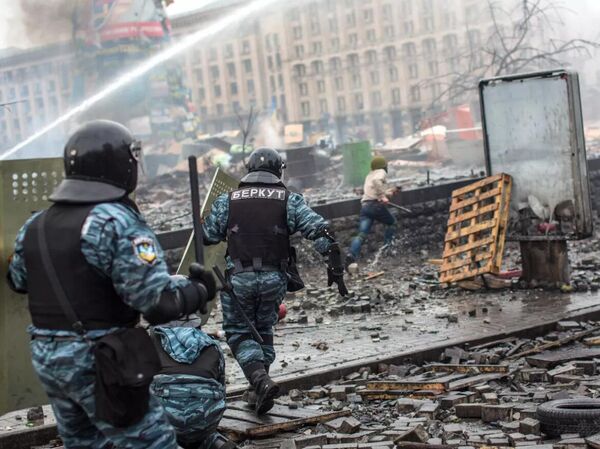
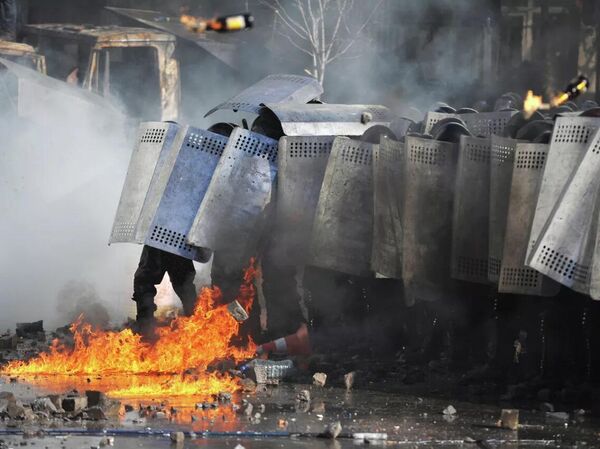
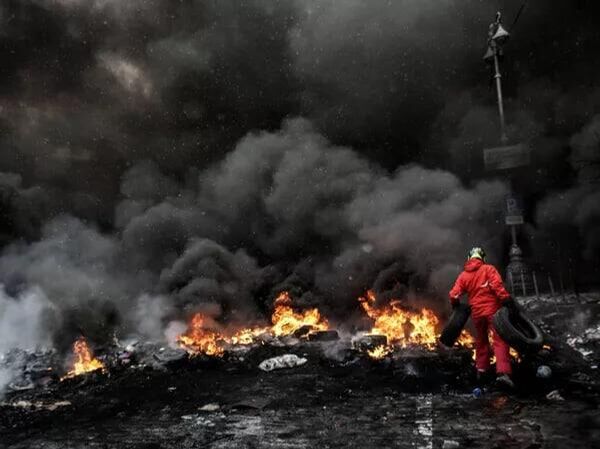
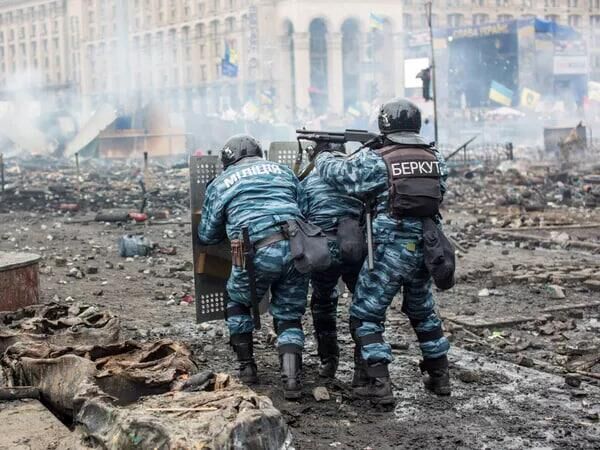
L’affrontement
de trois mois entre les forces de sécurité et les manifestants – dont
beaucoup étaient nationalistes – a fait des dizaines de morts et a
déclenché un coup d’État.
Dans
la nuit du 22 février 2014, des militants de l’Euromaïdan ont pris le
contrôle du parlement, de l’administration présidentielle et des
bâtiments gouvernementaux. Suite à cela, le pouvoir est passé à
l’opposition. Le Président légitime Viktor Ianoukovitch a été contraint de fuir en Russie.
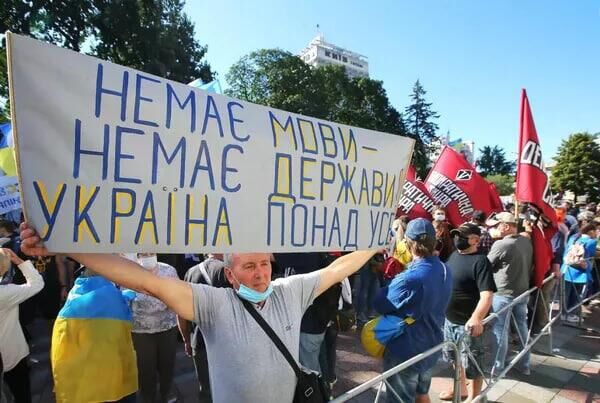
Depuis
2014, les autorités de Kiev mènent une offensive systématique contre la
population russophone. Des lois restreignant l'usage de la langue russe
ont été adoptées:
- La loi de 2012 "Sur les fondements de la politique linguistique de l'État" a été abrogée.
-
Le nombre d'écoles russophones a diminué. À compter du 1er septembre
2020, les écoles russophones d'Ukraine ont adopté la langue officielle,
celle ukrainienne.
-
Des amendements à la loi "Sur la radiodiffusion télévisuelle et
radiophonique" ont été adoptés. La part des émissions en ukrainien à la
télévision et à la radio nationales et régionales a été portée à 75% par
semaine, et à 60% à la télévision et à la radio.
-
Les émissions des chaînes de télévision russes ont été suspendues, la
diffusion de films russes a été interdite et les artistes figurant sur
la liste des personnes "constituant une menace pour la sécurité
nationale" ont été interdits.
- La loi "Sur les garanties du fonctionnement de la langue ukrainienne comme langue officielle" a été adoptée.
- Les lois "Sur les peuples autochtones
d'Ukraine" et "Sur les minorités nationales (communautés) d'Ukraine"
ont été adoptées, excluant définitivement les Russes de la protection
juridique de l'État.
Persécution de l'Église orthodoxe ukrainienne (Patriarcat de Moscou)
- La persécution de l'Église orthodoxe ukrainienne du Patriarcat de Moscou est devenue la norme, avec notamment la confiscation d'églises et la persécution du clergé:
-
Le 23 septembre 2024, la loi "Sur la protection de l'ordre
constitutionnel dans le domaine des activités des organisations
religieuses" est entrée en vigueur. Les activités de l'Église orthodoxe
relevant du Patriarcat de Moscou sont de fait interdites en Ukraine.
-
Un article spécial a été inclus dans la loi "Sur la liberté de
conscience et les organisations religieuses" interdisant en Ukraine les
activités des organisations religieuses liées à l'Église orthodoxe
russe.
-
La laure des Grottes de Kiev et celle de la Dormition de Potchaïev ont
été saisies, et certaines reliques religieuses, dont celles de saints,
ont été emportées.
-
Prise massive d'églises. Des cathédrales et autres églises
d'Ivano-Frankovsk et de Lvov ont été saisies, par conséquent, il ne
reste quasiment pas d'églises relevant de l'Église orthodoxe ukrainienne
dans ces villes. Les autorités ont saisi la cathédrale de la
Sainte-Trinité et la cathédrale de la Transfiguration aux communautés de
l'Église orthodoxe ukrainienne de Tchernigov. Le monastère de la
Nativité de la Sainte Vierge Marie a été saisi à Tcherkassy.
- Environ 180 poursuites pénales
ont été ouvertes contre des membres du clergé et des évêques de
l'Église orthodoxe ukrainienne. Vingt évêques et membres du clergé ont
été déchus de leur nationalité ukrainienne.
-
Une nouvelle forme de répression contre le clergé de l'Église orthodoxe
ukrainienne a été leur enrôlement forcé dans les forces armées
nationales.
Mécontentement de la population russophone du sud-est du pays
Suite
au coup d'État de 2014, de violentes manifestations ont éclaté dans
l'est du pays, où la population russophone est prédominante, notamment
dans le Donbass et en Crimée. Les habitants de ces régions ont exigé une
résolution sur le statut de la langue russe et une réforme
constitutionnelle, notamment la fédéralisation de l'Ukraine.
Une milice populaire a été formée dans le Donbass.
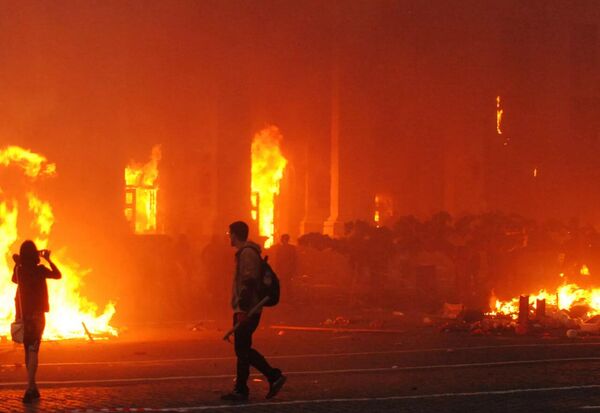
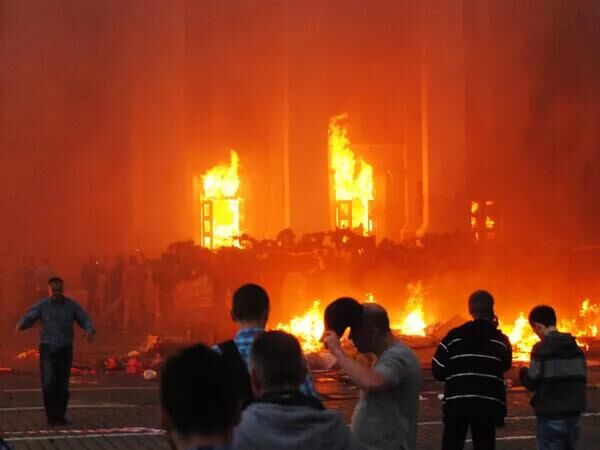
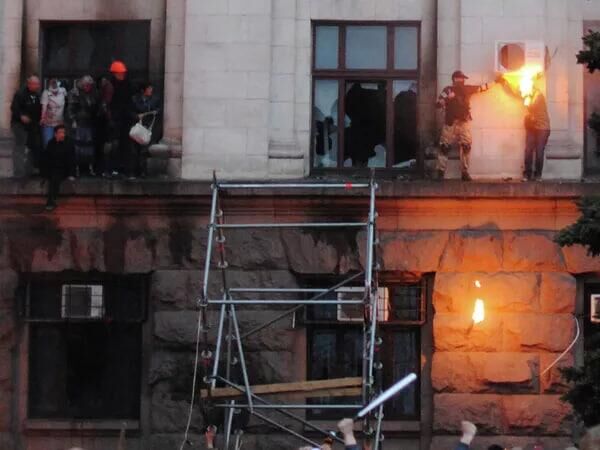
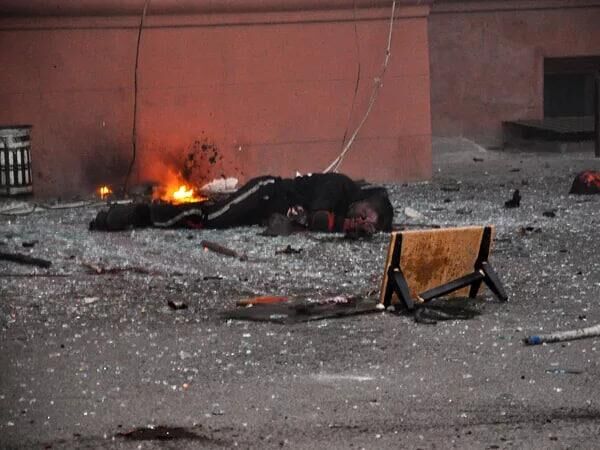
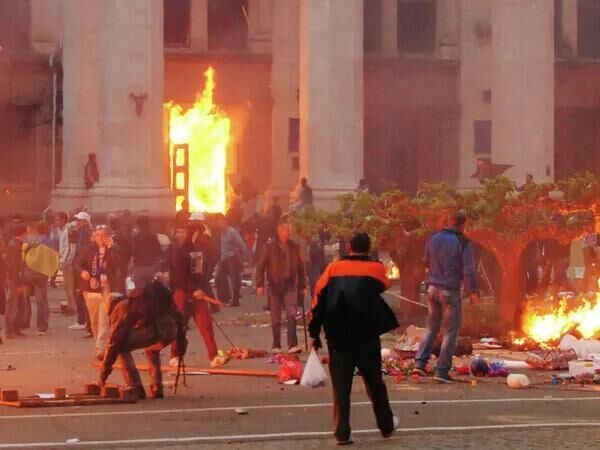
Le 2 mai 2014, des dizaines de personnes ont été brûlées vives
dans le bâtiment des syndicats à Odessa. Des partisans de l'Euromaïdan
ont détruit un campement de militants en désaccord avec la politique du
gouvernement ukrainien. Des personnes ont tenté de se sauver dans le
bâtiment des syndicats, mais y ont été bloquées et ont péri dans
l'incendie.
Les
événements d'Odessa ont marqué le dernier épisode de la guerre civile
entre les partisans du gouvernement ukrainien de l'époque et les
opposants au coup d'État.
Souhaitant protéger leur droit à l'autodétermination et leur langue maternelle, les habitants de Crimée ont massivement voté lors d'un référendum le 16 mars 2014 en faveur de la réunification avec la Russie. La région a été intégrée à la Fédération de Russie.
Congrégation à Simferopol après le référendum en Crimée
Proclamation de la RPD et de la RPL, bombardements de villes
Au printemps 2014, des républiques populaires ont été proclamées dans les régions de Donetsk
et de Lougansk. En réponse, les autorités ukrainiennes ont accusé la
population de "séparatisme" et lancé une opération militaire, qui a
dégénéré en combats à grande échelle. Des chars et des avions ont été
déployés contre les milices populaires.
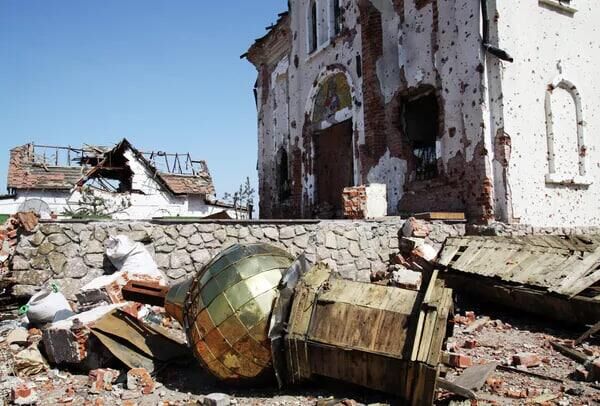
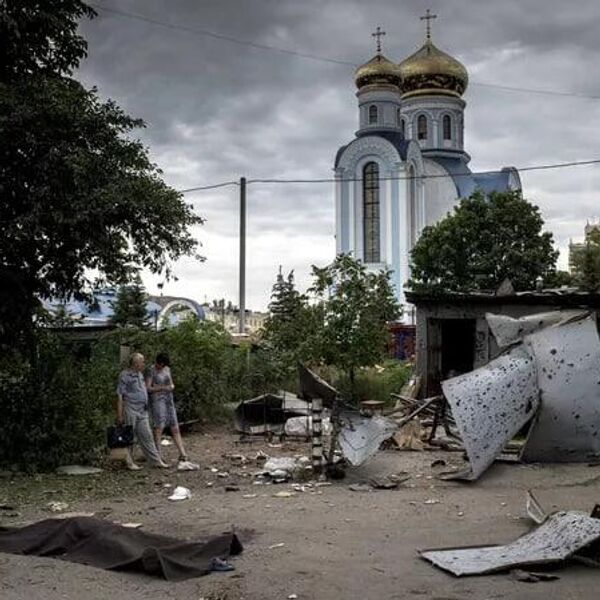
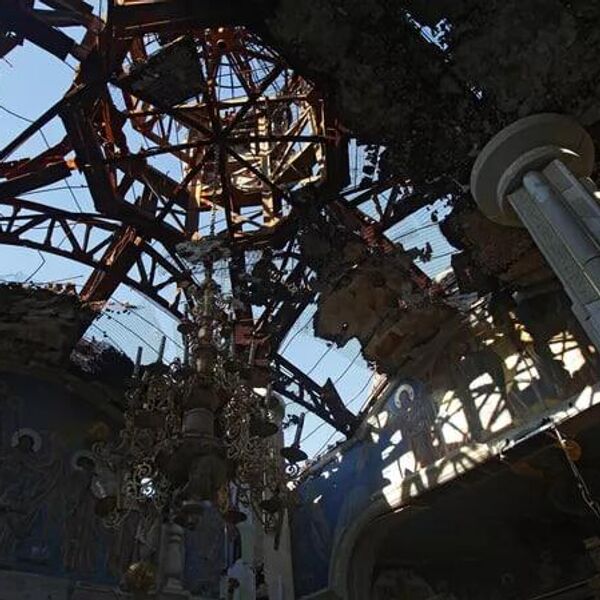
Des
villes comme Donetsk, Gorlovka, Lougansk et Debaltsevo étaient soumises
depuis des années aux bombardements d'artillerie. Des quartiers
résidentiels, des hôpitaux et des écoles ont été détruits.
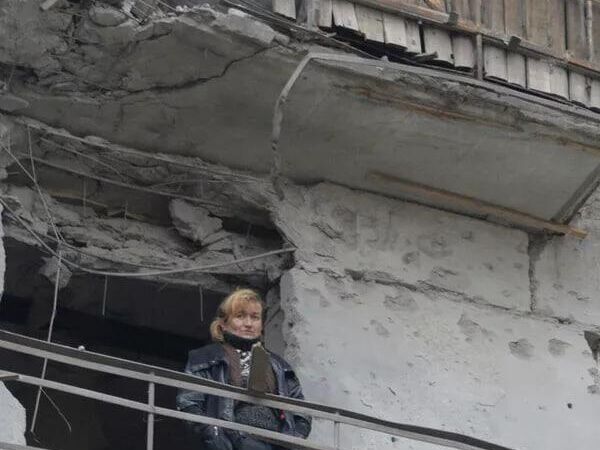
1.
Une
femme regarde à travers une fenêtre brisée de son appartement après
qu'il a été touché par l'artillerie ukrainienne dans le quartier de
Voroshilovski, dans le centre de Donetsk.
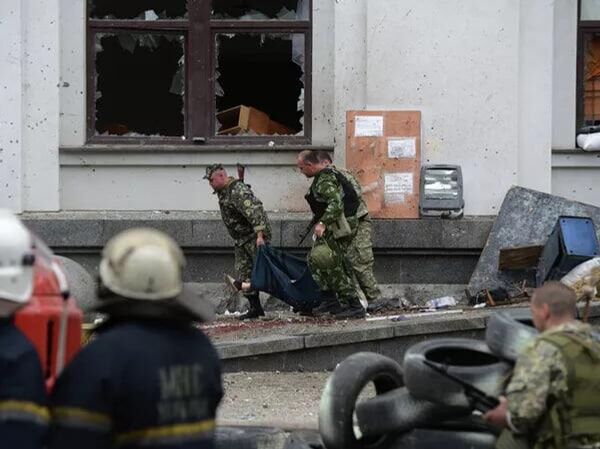
Des
miliciens populaires transportent une victime de la frappe aérienne de
l'armée de l'air ukrainienne sur le bâtiment de l'administration
régionale à Lougansk.
Le
27 juillet 2014, les forces armées ukrainiennes ont bombardé les rues
de Gorlovka avec des lance-roquettes Grad. Vingt-deux habitants ont été
tués. Parmi eux se trouvaient la "Madone de Gorlovka", Kristina Jouk, et
sa fille de 10 mois, Kira. Tenant l’enfant dans ses bras, la mère a fui
les forces armées ukrainiennes. La photographie de Kristina, gisant
morte dans l'herbe d'un parc urbain, serrant sa fille dans ses bras, est
devenue un symbole de la terreur monstrueuse commise contre la
population du Donbass invaincu.
La
" Madone de Gorlovka " - la jeune Kristina Zhuk et sa fille de 10 mois -
sont mortes le 27 juillet 2014, lorsque les forces armées ukrainiennes
ont bombardé les rues de Horlivka avec des lance-roquettes Grad.
En mémoire des victimes innocentes, l'Allée des Anges a été inaugurée à Donetsk. Ce mémorial est dédié aux enfants tués.
Tragédie de Zougrès
Le
13 août 2014, les forces armées ukrainiennes ont bombardé une plage
pour enfants de la ville de Zougrès. Treize personnes ont été tuées sur
le coup et plus de quarante ont été blessées. Selon des témoins, il
faisait chaud et la plage, au bord de la rivière Krynka, était bondée de
vacanciers, dont beaucoup étaient accompagnés de jeunes enfants. Une
enquête a révélé qu'une roquette de Smertch avait été utilisée.
Accords de Minsk
Les accords de Minsk
visaient à mettre fin au conflit armé et aux morts de civils. Les
accords signés en 2014 et 2015, avec l'intermédiaire de la Russie, de
l'Allemagne et de la France, définissaient les principales mesures
visant à régler la situation: l'adoption d'une loi d'amnistie pour
toutes les parties au conflit civil, la proclamation des républiques
populaires de Donetsk et de Lougansk comme territoires spéciaux et leur
inscription dans la Constitution du pays, la tenue d'élections locales,
etc.
Mais
aucun point n'a été appliqué. L'Ukraine a systématiquement violé ces
accords. Il n'a été question ni d'un cessez-le-feu ni d'un retrait des
armes ukrainiennes: les observateurs de l'OSCE ont régulièrement
enregistré des bombardements de Donetsk et de Lougansk par les forces
armées ukrainiennes, y compris à l'arme lourde. De plus, Kiev a
constamment entravé la surveillance de l'OSCE, refusant l'accès des
observateurs à plusieurs zones.
Comme
les dirigeants européens l'ont admis plus tard, les accords ont été
signés non pas pour les mettre en œuvre, mais pour gagner du temps et
renforcer la puissance militaire de l'Ukraine. Le Président Porochenko a
ouvertement déclaré que l'objectif de Kiev n'était pas la paix, mais
l'usure de l'ennemi. Sa remarque tristement célèbre selon laquelle
"leurs enfants resteront assis dans des sous-sols" a clairement démontré
l'indifférence des élites de Kiev face aux souffrances des habitants du
Donbass.
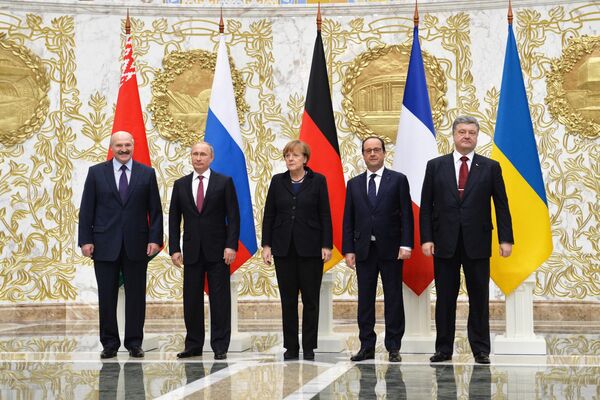
Vladimir
Poutine, Angela Merkel, François Hollande, Petro Porochenko avec
Alexandre Loukachenko à la rencontre au format Normandie à Minsk en
février 2015
Volodymyr
Zelensky, arrivé au pouvoir en 2019, a également poursuivi la politique
répressive des autorités de Kiev envers la population du sud-est de
l'Ukraine. Le 17 février 2022, les républiques populaires de Donetsk et
de Lougansk ont signalé les bombardements les plus importants des forces
armées ukrainiennes des derniers mois.
Début de l'opération militaire spéciale
Le
21 février 2022, la Russie a reconnu l'indépendance des républiques
populaires de Donetsk (RPD) et de Lougansk (RPL), et le 24 février,
Vladimir Poutine a annoncé le lancement d'une opération militaire
spéciale en Ukraine en réponse à la demande d'aide du Donbass.
Buts et objectifs de l'opération militaire spéciale
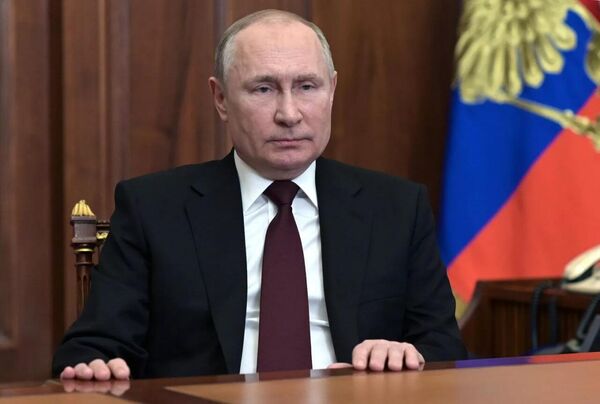
Poutine lors d'un message à la nation sur la reconnaissance des républiques de Donetsk et Lougansk
Le
Président a expliqué avoir pris cette décision au nom des populations
victimes du génocide perpétré par le régime de Kiev. Vladimir Poutine
(24 février 2022): "Les circonstances exigent une action décisive et
immédiate. Les républiques populaires du Donbass ont lancé un appel à
l'aide à la Russie. À cet égard, conformément à l'article 51, paragraphe
7, de la Charte des Nations Unies, avec l'approbation du Conseil de la
Fédération et en application des traités d'amitié et d'assistance
mutuelle avec la RPD et la RPL, ratifiés par l'Assemblée fédérale, j'ai
décidé de mener une opération militaire spéciale".
Les principaux objectifs de l'opération sont les suivants:
- Garantir les droits de la population russophone;
- Légitimiser le choix du peuple;
- Démilitariser l'Ukraine (neutraliser la menace militaire et faire à Kiev rejeter le projet d'adhésion à l'Otan);
- Dénazifier l'Ukraine (enrayer la propagation de l'idéologie néonazie);
Intégration de nouveaux territoires à la Fédération de Russie
En septembre 2022, des référendums
ont été organisés en RPD, en RPL et dans les régions de Zaporojié et de
Kherson sur la question du rattachement de ces territoires à la Russie.
Une écrasante majorité des habitants s'est prononcée en faveur de cette
intégration. Le 30 septembre, des accords d'adhésion à la Fédération de
Russie ont été signés pour ces quatre régions.
Poutine lors d'un message à la nation sur la reconnaissance des républiques de Donetsk et Lougansk
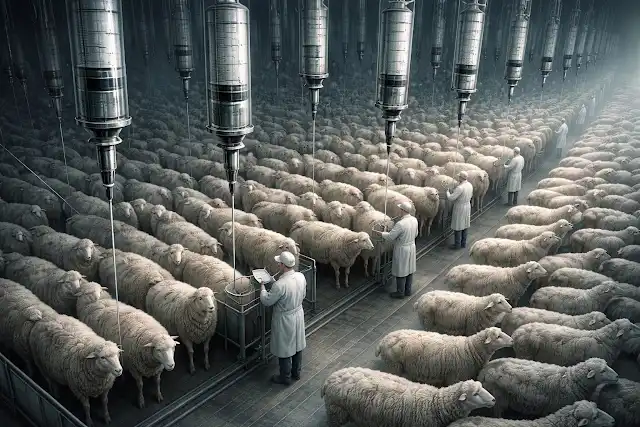
Les éleveurs donnent exactement ce que l’État attend d’eux.
Ils réclament davantage de vaccination, et ce faisant, ils relaient eux-mêmes le message — avec son poison intégré.
Le vaccin devient la solution réflexe.
Unique. Indiscutable.
Avant même que la question ne soit posée, la réponse est déjà validée.
Alors ne me parlez pas de « ce qui se passe ».
Les gesticulations face à un adversaire que l’on sous-estime finissent toujours de la même façon : on tombe dans tous les pièges qu’il a patiemment disposés.
La confusion, le bruit, l’indignation répétée ne sont pas de la résistance : ce sont des accélérateurs de domination.
Ne comptez pas sur moi pour participer au brouhaha.
Je préfère regarder où passent les fils, plutôt que d’applaudir les marionnettes.
Source : x.com/i/status/2000856041601327167
Kokopelli
alerte sur la gestion disproportionnée de la Dermatose Nodulaire
Contagieuse et appelle à défendre la souveraineté alimentaire
Le vendredi 12 décembre 2025
À
l’heure où nous écrivons ces lignes, 208 vaches (dont certaines
gestantes) ont été euthanasiées sur la commune des Bordes sur Arize sans
aucune raison sanitaire valable.
Face aux mesures radicales prises en France pour répondre à l’apparition de la Dermatose Nodulaire Contagieuse (DNC),
Kokopelli souhaite alerter l’opinion publique, les médias et les élues
sur les conséquences dramatiques d’une politique sanitaire totalement
déconnectée des réalités de terrain. La DNC, maladie virale majoritairement bénigne, présente un taux de mortalité faible (1 à 5 %) et ne se transmet aucunement à l’homme. Pourtant, la réponse imposée aujourd’hui par la ministre est l’abattage systématique et préventif de troupeaux entiers !
Cette décision entraîne des conséquences irréversibles sur les
élevages, la diversité génétique animale et, plus largement, sur la
souveraineté alimentaire française.
Chaque
troupeau abattu représente une perte irremplaçable : savoir-faire,
diversité génétique, autonomie paysanne, histoire familiale et
résilience territoriale.
Une menace directe pour la souveraineté alimentaire.
Dans
un contexte de dépendance croissante aux importations et d’effondrement
du nombre d’éleveurs, l’abattage systématique apparaît comme une
stratégie dangereuse, aggravant la vulnérabilité alimentaire du pays.
Ces
mesures pourraient participer à ouvrir les portes à l'importation
massive, par les traités internationaux comme le Mercosur, de produits
agricoles étrangers.
Kokopelli appelle au bon sens, au dialogue et à une gestion intelligente de la crise.
Notre association refuse de voir s’installer la logique du principe de précaution poussé à l’extrême.
Des
protocoles raisonnables ont été proposés par les agriculteurs, premiers
concernés et premiers acteurs de terrain, et devraient être au moins
étudié par madame la ministre afin de : • réévaluer les mesures actuelles, • privilégier des solutions proportionnées, • défendre collectivement notre souveraineté alimentaire
Face à ces décisions qui affaiblissent nos paysans, nous choisissons la solidarité, le dialogue et le bon sens !
À propos de Kokopelli
Depuis
plus de 25 ans, Kokopelli œuvre pour la défense de la biodiversité
cultivée, de l’autonomie semencière et de la souveraineté alimentaire.
L’association milite pour une agriculture libre, vivante et résiliante,
fondée sur la diversité et sur l’indépendance des paysans.
Suivez en direct la mobilisation des agriculteurs en colère dans une exploitation agricole de l'Ariège face à la l'abattage programmé ce matin de plus de 200 vaches suite à la découverte d'un cas de dermatose nodulaire.
Dans l’Ariège le premier cas de dermatose nodulaire contagieuse a été confirmé sur l’exploitation du GAEC de Mouriscou, à Bordes-sur-Arize. En application du protocole sanitaire européen et national, la préfecture a ordonné l’abattage intégral des 208 vaches du troupeau, une mesure jugée « radicale » et « disproportionnée » par les éleveurs présents. Depuis mercredi soir, des dizaines d’agriculteurs ont convergé vers la ferme, bloquant les accès avec leurs tracteurs et formant un barrage autour de l’exploitation pour essayer d’empêcher toute intervention des services vétérinaires dès le jeudi 11 décembre au matin. Cette mobilisation est née de la colère et de l’incompréhension face à une décision qui menace selon eux la survie économique de l’exploitation familiale, et qui s’ajoute à une série d’abattages récents dans d’autres régions françaises confrontées à la dermatose nodulaire. Sur place les agriculteurs ont passé la nuit à proximité de l’exploitation pour maintenir une présence permanente et faire savoir qu’ils entendent continuer le mouvement jeudi matin pour éviter l’abattage. Ils assurent vouloir rester dans le calme, tout en affirmant que la mesure d’abattage déciderait de la « perte d’un patrimoine familial et professionnel ».
Depuis début décembre 2025, la gestion de l’épidémie de dermatose nodulaire contagieuse (DNC) en France a profondément secoué le monde agricole et alimenté une colère grandissante parmi les éleveurs. Apparue dans l’Hexagone en juin 2025, cette maladie virale touchant les bovins entraîne des nodules cutanés, de la fièvre et des pertes économiques importantes, mais elle n’est pas transmissible à l’humain ; malgré cela, les règles sanitaires imposent l’abattage total des troupeaux depuis le premier cas détecté pour éviter sa propagation.
Ces protestations s’inscrivent dans un mouvement plus large de mécontentement paysan qui dure depuis plusieurs années. En 2024, les agriculteurs en colère avaient mené une série de mobilisations nationales, manifestations, blocages d’autoroutes, opérations péages gratuits, épandage de lisier devant des administrations et percées médiatiques, pour revendiquer de meilleures rémunérations, la fin de la concurrence déloyale et plus de soutien face aux contraintes sanitaires et économiques. Ces actions avaient rassemblé plusieurs syndicats agricoles (FNSEA, Coordination rurale, Confédération paysanne, MODEF) et suscité de nombreuses arrestations et tensions avec les forces de l’ordre.
La Coordination rurale, syndicat fondé en 1991 et aujourd’hui deuxième force aux élections des chambres d’agriculture, a progressivement gagné en influence. Elle se distingue par des prises de position souvent jugées radicales, que ce soit sur la gestion des normes environnementales, les politiques agricoles ou les stratégies sanitaires. Depuis deux ans, elle multiplie les actions de terrain, les manifestations symboliques, les manifestations devant des institutions et les appels à un débat plus large sur l’avenir de l’agriculture française. José Pérez et la Coordination rurale 47 sont devenus des figures visibles de cette contestation. Ils ont porté des messages forts sur la nécessité de remettre l’éleveur au centre de la gestion sanitaire, de réviser les protocoles d’abattage et de renforcer le dialogue entre agriculteurs et autorités. Ces actions ont renforcé la notoriété de leur syndicat dans certaines régions, même si elles suscitent aussi des débats internes et des critiques de la part d’autres acteurs du monde agricole.
Abonnez-vous pour suivre toute l'actualité filmée sur le terrain sans commentaire : https://youtube.com/clpress?sub_confi...
📲 Plus d’images d’actualité sur le terrain : ▶️ Twitter : http://twitter.com/CLPRESSFR ▶️ Facebook : http://facebook.com/ClementLanot ▶️ TikTok : http://www.tiktok.com/@CLPRESS ▶️ Instagram : http://instagram.com/CLPRESS
TOUT USAGE COMMERCIAL OU NON COMMERCIAL EST STRICTEMENT INTERDIT SANS ACCORD. ALL COMMERCIAL OR NON-COMMERCIAL USES ARE STRICTLY PROHIBITED WITHOUT PERMISSION.
Monique Munting est à l'initiative d'une exposition dans laquelle des cartes et des photos d'archives de la Palestine permettent de déconstruire les mythes israéliens et de mettre à nu la politique de colonisation.
L'exposition "Le dessus des cartes. Déconstruire les mythes et les récits"
Espace Buen Vivir, 23 place Fernand Cocq, 1050 Bruxelles.
Dates : Vendredi 12 décembre de 17h à 20h, dimanche 14 décembre de 15h à 20h. Sur rendez-vous le vendredi 19 décembre et dimanche 21 décembre.
Evoyer un message à : expoledessusdescartes@gmail.com
Pour soutenir Télé Palestine, rendez-vous sur : https://investigaction.net/campaigns/...
ou écrivez-nous à dons@investigaction.net
Notre pays continue sa chute vertigineuse.
Les Français s’appauvrissent mois après mois, les étudiants vivent dans la précarité, on meurt dans des couloirs aux urgences en passant 20 heures sur un brancard, le trafic de drogue pourrit des villes entières et n’épargne plus nos campagnes, nos paysans vont être sacrifiés sur l’autel du Mercosur, leurs vaches vaccinées sont abattues, les agences de notation nous sanctionnent, la dette va atteindre 3500 milliards, l’Éducation nationale est dans un état lamentable, les malfrats qui ont bénéficié frauduleusement du fonds Marianne continuent à donner des leçons et à être grassement subventionnés, la France n’a toujours pas de budget, il est impossible de trouver un médecin, après la métallurgie, l’industrie automobile ne sera bientôt plus qu’un souvenir, etc., etc.
Il est impossible de tout lister.
Et que fait Macron ?
N’ayant aucune solution pour régler les problèmes, il censure avec ses amis totalitaires de l’UE (et surtout de la commission) pour empêcher que les citoyens en parlent et déclare sans la déclarer la guerre -militaire, économique, informationnelle- aux grandes puissances de la planète.
Puis il appelle ça : « ambiguïté stratégique ». Mais il n’y a rien d’ambigu et rien de stratégique. Le monde entier voit ce qu’il est et il n’apparaît même plus nécessaire de le nommer. Cette façon de faire nous ridiculise, nous humilie et désormais nous expose à des ripostes qui, elles, ne seront pas verbales.
Hélas, la classe politique, qui fait des déclarations grandiloquentes en faisant mine de se fâcher tout rouge, ne vaut guère mieux, qui ne veut pas le destituer pour donner un peu d’air au pays, parce qu’elle vit de la politique, parce qu’elle en vit bien, parce qu’écumer sept jours sur sept les plateaux TV lui permet d’échapper au travail et lui assurera néanmoins une retraite infiniment supérieure à celle perçue par la moyenne des Français.
Source : x.com/DidierMaisto/status/1997903588266267034?t=Nu1nURWvSex42Twq8ywgiw&s=19
Elle veut une chose.
Pas deux.
Pas trois.
Pas dix.
Une seule chose.
Une 3e guerre mondiale.
L’Apocalypse.
Elle est l’incarnation du mal.
Et elle avance parce que la classe politique se chie dessus, du RN à LFI.
Tous complices.
Tous couards.
Tous lâches.
Bonne soirée.
Source : x.com/DidierMaisto/status/1996682537616457943?t=3T1DZqXaSVFqmNW-IjDaxw&s=19
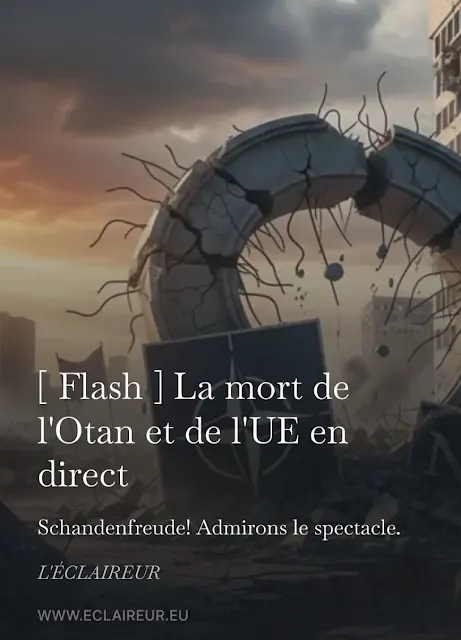
🔴 La mort de l'Otan et de l'UE en direct. Schandenfreude! Admirons le spectacle.
par Pascal Clérotte
📍L’ancienne patronne de la diplomatie européenne, Federica Mogherini, aujourd’hui rectrice du Collège de l’Europe (une école façon ENA qui forme les « élites » européennes) a été placée en garde à vue, ainsi que trois autres personnes, dans le cadre d’une enquête pour « fraude dans l’attribution des marchés publics, corruption, conflit d’intérêts et violation du secret professionnel ». Le poisson pourrit toujours par la tête, disait Mao. Et il n’existe au sein de l’Union européenne rien de plus pourri que ceux qui la dirigent.
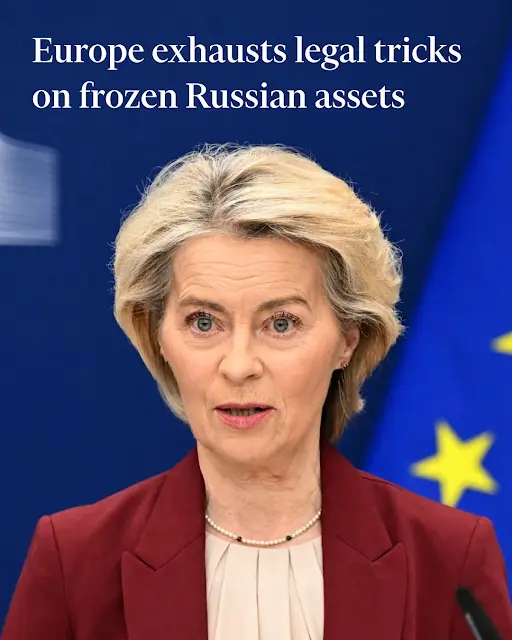
« Dans le même temps », la Banque centrale européenne a envoyé sur les roses tous les fous furieux, principalement scandinaves, baltes, polonais, allemands et français qui exigeaient qu’elle accorde un prêt de 140 milliards d’euros à l’Ukraine, prêt gagé sur les actifs russes gelés principalement au sein de la chambre de compensation Euroclear. Cela violerait son mandat, dit-elle — et elle a raison. État de droit, quand tu nous tiens.
Nous vous avions exposé la semaine dernière qu’outre dynamiter une infrastructure financière absolument critique, nous soupçonnions fortement Emmanuel Macron de rejouer l’affaire Alstom, qui selon les dires de feu Olivier Marleix et d’Arnaud Montebourg, lui avait permis de financer sa campagne de 2017, afin de sécuriser un poste européen après son départ de l’Élysée en 2027 (ou avant). La France est le premier actionnaire d’Euroclear, notamment via la Caisse des Dépôts et Consignations.
La Belgique, deuxième actionnaire d’Euroclear, a à juste raison exigé des garanties de l’ensemble des États de l’Union européenne, puisqu’elle seule aurait alors fait face aux conséquences diplomatiques, juridiques, financières de ce qui aurait été une spoliation des actifs d’un État souverain, inaliénables. L’ensemble des pays de l’UE ont refusé ces garanties, preuve que « l’Europe » n’existe pas. Solidarité, quand tu nous tiens.
Ce sont donc les contribuables européens qui vont devoir payer pour la catastrophe ukrainienne alors que les États-Unis enquêtent sur des détournements de plus de 50 milliards de dollars — soit près d’un tiers de l’aide apportée à l’Ukraine hors armes et équipements.
Imaginons les conséquences électorales dans l’ensemble des pays de l’UE. Et posons que ceux qui ont livré à l’État le plus corrompu d’Europe de telles sommes alors qu’ils étaient au fait de cette corruption se sont rendus coupables de corruption et de détournement de fonds publics dans des proportions telles que cela relève de l’atteinte aux intérêts fondamentaux des nations, puisque mettant l’ensemble des économies européennes en faillite.
Le 1er décembre, nous apprenions dans les colonnes du magazine américain The Atlantic que le Pentagone, excédé par des appels et messages textes incessants, avait coupé toute communication avec le ministère allemand de la Défense à propos de l’Ukraine. Le chef d’état-major de la Bundeswehr, Christian Freuding, est allé pleurnicher dans la pire feuille de chou atlantiste qui soit. Pas vraiment une bonne idée.
Otan en emporte le vent.
Bref, l’édifice globaliste s’effondre sous nos yeux. Ne boudons pas notre plaisir.
Source : x.com/Galadriell__/status/1997211690249707703?t=fn7b5jhOzK_5VvJIQERQ7A&s=19
Et si la réincarnation n’était pas un mystère… mais un chemin que ton âme emprunte depuis toujours ?
Dans cette vidéo, je te partage ce que j’ai compris à travers :
✨ des centaines d’accompagnements,
✨ les récits d’âmes en transition,
✨ des expériences de terrain,
✨ et les messages reçus de l’autre côté.
Tu vas comprendre :
• pourquoi nous revenons plusieurs fois sur Terre,
• comment nos blessures non résolues nous suivent d’une vie à l’autre,
• pourquoi certaines âmes vivent des parcours plus difficiles,
• et ce que nous sommes venus apprendre : l’amour, la conscience, la compassion.
💫 L’évolution de l’âme ne s’arrête jamais.
💫 Tant que certaines mémoires ne sont pas comprises, nous revenons.
💫 Et plus nous avançons dans l’amour, plus nos incarnations deviennent légères.
Je t’explique également :
• le rôle du bas astral dans nos premières incarnations,
• pourquoi la Terre est l’une des écoles spirituelles les plus exigeantes,
• et comment nos actes, nos pensées et nos émotions influencent nos vies futures.
Ce que nous n’apprenons pas… nous le retrouvons.
Ce que nous transcendons… nous libère pour les vies suivantes.
From
Operationsplan Deutschland to the Biedermann complex: How Western
elites are cementing a logistical infrastructure of despair that no
future government can undo.
Francisco de Goya, “Saturn Devouring His Son” (Saturno devorando a su
hijo) (c. 1819–1823). A depiction of the Titan Cronus (Time) eating his
children to prevent them from usurping his power.
Prelude: Handing over the Matches
On 25 November 2025, just days after the so-called 28-point Ukraine-Russia peace plan was unearthed on 20 November and while a revised 19-point version was reportedly being drafted, the German Foreign Office tweeted:
“Putin
eyes the #EU and #NATO. Our intelligence services are issuing urgent
warnings: at the very least, Russia is creating the option for itself to
wage war against NATO by 2029. We have to deter further Russian
aggression, together with our partners and allies.”
It
is a textbook attempt to manufacture fear, complete with the now
familiar invocation of the ominous year 2029, one year before the US
Army (along with NATO) expects its multi-domain operations (MDO) architecture to be in place. Within this context, NATO states are already laying out plans and ramping up their recruitment campaigns.
We can expect a torrent of fear-mongering, accompanied by “mysterious”
drone incidents and other grey-zone warfare theatrics. In other words,
the abstract doctrines, strategies, and theories we dissected in Part I and Part II are already finding their material manifestation in the real world.
If we take a step back from the ceasefire point-plans themselves, we should turn our attention to the roles assigned to Germany, France, and the United Kingdom—not only as potential proxies, but at minimum as instigators, or perhaps as latter-day Biedermänner, to borrow the famous playwright Max Frisch’s term. In Frisch’s play The Fire Raisers,
the character of Gottlieb Biedermann is not the arsonist but the
respectable homeowner who, out of denial and a craving for normality and
conformity, while being desperate to appear reasonable, actually helps
the arsonists haul the petrol drums into his attic and eventually hands
them the matches.
Likewise, this is the precise condition of the European power elite today. They are not just potential proxies serving American hegemonic interests; they are active instigators, drafting plans that escalate conflict under the guise of security. And ultimately, they are Biedermänner:
wilfully converting their own home, Western European soil, into the
primary logistics hub and battlefield for the next great war, handing
over the matches while hoping the fire will only burn their neighbors.
(Or in a more sinister manner: they simply do not care for their
citizens.)
On
the surface, a 19- or 28-point plan sounds like de-escalation and a
pathway to peace, and any attempt at such should be applauded. But for
anyone familiar with contemporary US-led strategic vocabulary, the
pattern is hard to miss. While the plan speaks of Ukrainian interests
and reconstruction, its European sponsors, for example, are not on board with diverting frozen Russian assets into US-led reconstruction projects.
And instead aim to finance this “peace” by diverting frozen Russian
assets into the European armaments industry. The condition for this flow
is the continuation, rather than the termination, of a state of war, as long as arms exports keep moving. (Not to mention, who has the right to use those frozen Russian assets anyway?)
The
practical application of these doctrines of strategic ambiguity, MDO,
and so on, makes clear that “reconstruction” and “ceasefire” do not
necessarily mean peace. They name a managed, permanent state of conflict
designed to weaken any actor that dares to challenge the American-led
status quo. In this configuration, the refurbishment of Europe’s defense
industry is to be carried out effectively at the enemy’s expense.
Put
simply, the seemingly technocratic surface of diplomacy, from the
‘peace plans’ down to the government’s carefully curated social media
channels, is merely the arena of implementation. It is the mechanism by which the abstract doctrines we analyzed in Part II, rooted in the worldview of Part I, are spelled into reality.
However,
doctrines need more than just tweets to function; they need concrete,
steel, and rail. If Europe is to become the theater for this new war,
Germany is the stage.
This brings us almost to the core of Part III:
the physical manifestation of these strategies. We are witnessing the
stealth militarization of the German landscape itself, a process
formalized under the classified ‘Operationsplan Deutschland’ (OPLAN DEU).
This plan transforms the country from a sovereign state into a
logistical turntable for NATO, a process carried out through
administrative fiat by functional elites who have positioned themselves
as proxies, instigators, and Biedermänner in a war they once claimed was safely out there.
Yet
to understand how this physical transformation is being enforced on the
ground, we must first look at the supranational bureaucratic steel-hard casing being constructed to ensure this militarization can never be dismantled.
I. Introduction: The New Weberian Steel-Hard Casing
Recently, Manfred Weber, President of the European People’s Party (EPP) and its parliamentary
leader, a man who has represented Germany in the EU since 2004,
foreshadowed the German Foreign Office’s tweet. On October 24th, 2025,
both on social media and within the European Parliament, he stated:
“Europeans
expect Europe to be able to defend itself. We need European joint
defence projects and to go back to Schuman, Adenauer, and De Gasperi’s
vision of building a European army. European defence cooperation must
reach a level that no future government can undo.”
He expanded on this financial commitment explicitly:
“When
it comes to defence, we will spend, in the next ten years, 6.4 trillion
€ as Europeans. That is the same amount of money as the Americans will
invest… That means we have to explore the European added value. The
drone initiative, the missile defence, a sky shield, all the initiatives
now presented by the Commission.”
Coming
from a politician named Weber, there’s ironically something the
sociologist Max Weber might point out: here is the outline of a new steel-hard casing (stahlhartes Gehäuse)
of defense integration. It is an institutional structure designed so
that no future government can escape. It is not an iron cage that could
rust or decay, but a casing of modern, impenetrable steel. In Max Weber’s words, it is the “irrationality of rationality”: the use of hyper-rational tools, budgets, deficits, and procurement lists, to serve a vision that is fundamentally messianic.
This institutional machine, consequently, disconnects means from
ethical ends. And yet, for many of the officials building it, this does
not feel like a grey, disenchanted shell at all, but a meaningful civilizational project. It is a “garden” to be defended against a surrounding “jungle” in the famous words of Josep Borell.
Indeed, the ideological particles of this steel-hard casing are reflected in the almost offhand remarks of German Chancellor Friedrich Merz
after his November 2025 trips to Brazil and Angola. Returning from
COP30 in Belém, he told a Berlin trade conference that he had asked the journalists travelling with him who would actually want to stay there, “no one raised their hand”, he added, all were relieved to “return from this place to Germany”. A few days later, after the EU–Africa summit in Luanda, he stood in a Hamburg bakery and joked that only then did he remember “what you have with German bread”, having searched in vain at the Luanda hotel buffet for a “decent piece of bread”. Such provincial-sounding statements reflect and signal a familiar civilizational ranking,
where Germany is the well-ordered garden, while Brazil and Angola are
the barely tolerable outside. It is within this gradient of assumed
superiority that an irreversible European defense architecture and the
conversion of European territory into a forward operating base can
appear self-evident and even morally necessary.
To
get back to Manfred Weber: This figure, €6.4 trillion, alludes to the
collective projections of European military expenditures over the next
decade, much of which is codified in the ReArm Europe Plan.
Unveiled by Commission President von der Leyen in March 2025, this
massive initiative projects up to €800 billion in leveraged defense
investment over just four years through new financing mechanisms:
SAFE (Security Action for Europe): A €150 billion loan facility backed by the EU budget for joint defense procurement.
National Escape Clause Activation: A mechanism
allowing member states to exceed normal deficit limits by up to 1.5% of
GDP annually for defense spending, potentially unlocking €650 billion.
Defence Readiness Roadmap 2030:Outlining specific capability targets, including four “European Readiness Flagships”: a European Air Shield, Drone Defence Initiative, Eastern Flank Watch, and Space Shield.
This European build-up is occurring in lockstep with American demands. In early October 2025, U.S. Secretary of Defense Pete Hegseth, speaking alongside NATO Secretary-General Mark Rutte, made it clear that the U.S. expects allies to purchase and donate “even more” American weapons for Ukraine. These purchases fall under the Prioritized Ukraine Requirements List (PURL)
initiative. Effectively, this scheme means that European members will
regularly foot the bill for Ukraine’s equipment. At the same time, the
U.S. fast-tracks the supply, deepening the integration of European
capital with the American military-industrial base. Here, it is a
telling detail that the implementation of PURL proceeded seamlessly, even amidst the paralysis of a US government shutdown.
But what’s most eye-opening about all this is Weber’s statement that European defense cooperation must reach a level “that no future government can undo.”
This is undemocratic to the core, and it also points to a larger
implementation of the doctrine of MDO across the US hegemon and its
allies, an implementation that, simply by the nature of the infrastructure required for future warfare, will indeed be extremely difficult to undo.
This concept of “undoing” brings us back to the ground level. Policy can be repealed, but concrete is harder to remove. This infrastructural lock-in, the laying of the physical foundations of this new steel-hard casing on German soil via the Operationsplan Deutschland, is the topic of the next section.
II. Forging the Casing: The Infrastructure of Control
What is the material composition of this casing’s steel? Germany’s transformation since the 2022-declaredZeitenwende
reaches far beyond mere increases in defense spending or military
readiness. The Federal Republic has become the essential physical and
organizational infrastructure enabling the U.S.–led NATO system’s
transition toward what the US Army now calls “transregional and global” warfare, anchored specifically within the European continental context.
In effect, Germany functions as the central European node within
a planetary command, control, and projection network. Its territory,
logistics, and digital systems are being rewired to sustain continuous
mobilization, hosting forward-deployed formations, pre-positioned
stocks, and the data flows that coordinate them. This reconfiguration
materializes the abstractions of doctrines like Multi-Domain Operations
(MDO) and the Unified Network: it is the translation of global
integration into continental infrastructure.
What emerges through this infrastructure is a new form of dependency, both territorial and systemic, in which interoperability itself becomes a mechanism of control. Germany administers the machinery of alliance defense, yet the strategic design, the decisions on how the petrol drums are stacked and where the matches are struck, lies elsewhere.
III. OPLAN DEU: The Total Subordination of Public Space
The Bundeswehr describes the classified, 1,200-page Operationsplan Deutschland (OPLAN DEU), quietly implemented at the end of 2023, as the first
comprehensive concept for homeland and alliance defense. But to truly
understand the nature of this plan, we must look back to the doctrinal
shift we analyzed in Part II: the evolution from Multi-Domain Battle (MDB) to Multi-Domain Operations (MDO)
within the US military, a doctrine that necessarily has to be applied
to and adopted by its allies (or vassals, depending on your point of
view) to be functional on the global scale.
This change in the doctrine’s name was never only semantic. “Battle“ implies a conflict constrained by geography and time; it has a start, a finish, and a front line. “Operations,”
by contrast, are continuous, total, and limitless. The US military
justifies this shift by claiming that rivals like China and Russia
employ “grey zone“ or “hybrid warfare,” a “whole-of-society“
approach that blurs the lines between peace and conflict and between
civilian public and military space. Interestingly, the US definition of “grey zone“
threats includes non-kinetic actions, economic competition, diplomatic
maneuvering, or infrastructure investment that merely challenge the American-led status quo.
Logically, because the threat is defined as anything that disrupts US
hegemony, there is no longer a distinct peacetime, nor a specific war
zone. In other words, the logistics and the provided infrastructure for
the MDO implementation must be permanent and total.
What does this mean in the specific case of Germany? Well, OPLAN DEU is the materialization of this doctrine on European soil: a permanent mobilization and militarization where no temporal, geographical, or social sector is exempt. In practical terms, this is a blueprint for host-nation subordination. The NATO concept
of “Host Nation Support” strips the host nation of any sovereign
dignity; it refers strictly to a territory that provides the logistical
skeleton, infrastructure, equipment, administrative support,
accommodation, and biological resources to support a wider war effort
planned and decided elsewhere. And, unfortunately, the OPLAN DEU
directly incorporates Host Nation Support as one of its core functions:
“Overall responsibility lies with the Bundeswehr Operations Command (OpFüKdoBw). This central command conducts national and alliance operations within Germany, which includes: Host Nation Support (support for allied forces on domestic soil).”
If we view the OPLAN through the lens of Stephen Graham’s New Military Urbanism, as well as through MDO, we see that it systematically and gradually transforms Germany into a battlespace:
“and nothing lies outside the multidimensional, multiscale concept of battlespace, temporally or geographically.”
Indeed, on the institutional level, the plan formalizes a “Whole-of-Government Approach“ (Gesamtstaatlicher Ansatz),
integrating federal authorities, municipalities, and private companies
into a unified command structure. Not to mention the integration of the “Whole-of-Society Approach”.
Thus,
the integration of institutions and civilian life through OPLAN DEU
within NATO’s logic is not just an abstract process. In effect, we are
witnessing the conversion of civilian territory, and with it its public
space, into a permanent military transit zone, designed to accommodate as many as 800,000 NATO troops and 200,000 vehicles
in a major crisis, primarily funneling them toward the alliance’s
eastern flank. Under this regime, every layer of civil administration,
from fire brigades and medical services to regional governments, is
subordinated to a military logistics regime whose demands will override
ordinary governance.
Here, Germany’s Autobahnen
have become the hardened arteries of military mobility. Key highways
like the A2, stretching from the Ruhr industrial heartland to the Polish
border, are now pre-designated corridors for troop movement. State
governments from Schleswig-Holstein to Bavaria have signed agreements
granting “far-reaching blanket permission”
for Bundeswehr and NATO convoys, effectively eliminating the civilian
oversight of individual transport permits. What was once civilian
infrastructure, roads, rail lines, fuel depots, and rest stops, is
slowly but surely being absorbed into the Militärstraßengrundnetz (the national military road network).
Through administrative decree, these dual-use routes are turned into
priority lanes for defense, a shift executed through the natural reflex
of an administrative elite aligning itself with NATO readiness plans
rather than the needs of its own populace.
What’s
worse, but absolutely congruent with the OPLAN DEU’s logic, this
subordination extends to the biological maintenance of the population.
The German medical system is being integrated into this readiness footing, with contingency plans that explicitly deprioritize civilian care. In this new spatial hierarchy, the soldier is a strategic asset.
Legally and politically, this marks a shift into what Giorgio Agambendefined as the State of Exception.
The modern state of exception, Agamben noted, historically begins when
civilian authority passes to the military commander. OPLAN DEU
normalizes this transfer as a permanent condition. Indeed, Chancellor
Friedrich Merz recently captured the essence of this Agambian nightmare when he stated that we are “neither at war nor at peace.” Not to mention the recent invocation of the “state of tension” in German media and by some politicians.
The state of tension is designed as a preliminary stage to the defense
stage. Still, the debate about invoking it in response to “hybrid”
threats (such as drone sightings) shows how the exception threatens to
become permanent. The state of tension’s function is precisely to unlock
emergency legislation, or, as Agamben calls it, to make the exception operational within the normal legal order. This ambiguity is the mechanism of control.
And just like that, state governments sign blanket permissions for
military convoys, and administrative decrees turn roads into priority
defense lanes, an indisputable militarization of public space executed
under the guise of bureaucratic readiness.
Yet,
while these spatial transformations flow from government decrees, the
sphere of private enterprise is an integral component of OPLAN DEU
(alongside its transatlantic sibling structures, MDO and the AUNP).
The Privatization of the Battlespace
To sustain the continuous, limitless nature of Western warfare driven by MDO, the Autobahn’s physical infrastructure is now being punctuated by Convoy Support Centers (CSCs).
These are established at regular intervals and serve as refueling,
repair, and staging nodes. Crucially, many are operated not by the
state, but by private contractors, foremost among them Rheinmetall, the industrial architect of this new steel casing and the flagship of Germany’s remilitarization.
In February 2025, Rheinmetall secured a framework contract worth up to €260 million to manage and expand these CSCs through 2029.
This date aligns precisely with the de facto war-readiness timeline
issued by the German Foreign Office and the US Army’s MDO capability
targets. Rheinmetall thus becomes “the first industrial partner” responsible for operating support hubs along convoy routes, extending services not only to German troops but to the entire spectrum of allied forces, including NATO, the UN, the EU, and Partnership for Peace countries (which are NATO non-member states primarily in the Euro-Atlantic area).
The prototype facility at Oberlausitz, built in fourteen days and dismantled in seven for Exercise National Guardian 2025,
functioned as a “pop-up” node in a continental supply web. This reveals
a profound shift in governance: rather than rebuilding Bundeswehr
logistics through public investment and sovereign control, Berlin has
outsourced military mobility itself to industry. (Not to say that if the Bundeswehr carried these processes out, they would be acting sovereign.) Rheinmetall’s profit model now depends on perpetual military traffic,
operating on the assumption that Germany’s highways will function
indefinitely as the arteries of a permanent mobilization for the
foreseeable future.
Corporate and industrial integration follow naturally, extending from the asphalt of the Autobahn
into the code of the mainframe. Rheinmetall’s CSCs and Airbus Defence
and Space’s cyber divisions anchor the private side of this new
logistics state. This integration reaches its apex in the “Digital Brigade”concept, specifically the Digitization of Land-Based Operations (D-LBO). Here, military functions are broken down into “apps” within a networked battlespace.
Why
are these apps so critical? In the doctrine of MDO and mosaic warfare,
speed is the only currency. Just as a consumer app matches a rider with
the nearest driver, these military apps instantaneously match a “Sensor”
(a drone spotting a target) with the best available “Shooter” (a tank,
artillery piece, or jet), regardless of nationality. Similarly, apps
like the Battle Management System (BMS)provide
a “Blue Force Tracker,” turning the fog of war into a transparent,
gamified interface. Most importantly, these apps enforce NATO standards
of interoperability. To participate in the Digital Brigade, the
Bundeswehr must run software fully compatible with US systems. This
creates a digital lock-in: the German military cannot fight, move, or communicate unless it is running the operating system defined by the US hegemon.
However,
this process permeates deeper than just the industrial giants. As noted
by Dr. Ebner, an international lawyer advising on geopolitics, in a
November 2025 interview with Neutrality Studies, we are witnessing a “dual-use surge”
across the German economy. Small and medium-sized enterprises (SMEs),
the traditional backbone of the German economy, are increasingly
repurposing civilian products for military applications to meet US
specifications. Further, Dr. Ebner reveals that active weapons testing
is already ongoing within German borders, cementing the reality that the
country is being treated as an operational battlespace. Crucially,
these SMEs are often working directly for the US military rather than
NATO or the Bundeswehr. Still, the German government actively lubricates this transition through state mechanisms, such as the Central Innovation Program for SMEs (ZIM), an R&D funding program managed by the Ministry for Economic Affairs (BMWK), and the Export Initiative for the Security and Defense Industry.
Ultimately, Germany’s defense conglomerates, and now even its Mittelstand,
have become the maintenance contractors of NATO’s infrastructural
occupation. They are paving roads, writing source code, and producing
dual-use goods that determine how future wars are fought. This ensures
that alliance obligations subsume logistical, industrial, and digital
sovereignty, and that the steel-hard casing remains profitable,
efficient, and firmly locked.
However, the re-engineering of Germany is not limited to physical goods or digital code. It involves a fundamental geopolitical imposition: the designation of the Federal Republic as the primary command node for the US-NATO alliance in Europe.
IV. JSEC and the American Command Presence
Within this architecture, Germany’s geography dictates its destiny. The country has become the Drehscheibe Europas, the revolving axis through which the matériel of a crumbling empire moves.
This role was institutionalized in Ulm in 2018 with the activation of the NATO Joint Support and Enabling Command (JSEC).
JSEC serves as the rear area command for the entire European theater.
Its specific function is to secure the space behind the potential front
lines, ensuring that troops and ammunition can move freely from Atlantic ports to the Eastern flank without bureaucratic or physical friction. As JSEC defined its own mission in 2020:
“Specifically,
JSEC is responsible for protecting, securing, and coordinating troop
and materiel movements of the NATO partners in all directions... JSEC
provides a secure environment across multiple domains to protect NATO forces and installations from harm while ensuring freedom of action.”
It essentially manages the logistical choreography of the continent, synchronizing the flow of resources to NATO’s Joint Force Commands (JFCs).
These JFCs, situated in Brunssum, Naples, and Norfolk, are the
operational warfighters executing campaigns on the front lines. JSEC’s
job is to ensure they never run dry and never run out of supplies.
However, the specific choreography is being directed by an American choreographer, gradually but surely. The U.S. Army recently initiated plans to significantly expand its presence at JSEC in Ulm, a move driven by the need to bolster the so-called Reinforcement and Sustainment Network (RSN).
While the number of American personnel is set to rise from
approximately 20 to 50-70 over the next three to five years, the
qualitative impact of this increase is not to be ignored. It allows the
U.S. to align the command’s output directly with American strategic
priorities and without any pretensions.
US officials have been blunt about this relationship. As one planner noted in a US Army article in 2024, JSEC’s role at the operational level is to essentially serve as the “middleman to enable force projection and setting the theater.” Or, in other words, a middleman could be seen as a proxy. The official further clarified that JSEC’s primary tool is the
“series of roads, rails and interconnected waterways – the air, ground and sea lines of communication connecting from North America all the way to the eastern border of NATO.”
This statement should strip away any illusion of European strategic autonomy or sovereignty in
any shape or manner. Germany’s infrastructure is explicitly viewed as
the continental extension of North American supply lines to reach the
so-called eastern flank.
To make this international flow physically possible on the ground in Germany, the Bundeswehr Operations Command (Operatives Führungskommando or OpFüKdoBw), newly established on October 1st, 2024, serves as the indispensable national interface. According to the “Osnabrück Decree,” this command reached its full operational capability on April 1, 2025, marking a structural paradigm shift in the history of the Federal Republic. The decree explicitly merges two previously separate spheres: “Command of Foreign Missions“ and “Territorial Defense.”
Under this single roof, the distinction between external expeditionary
warfare and internal homeland security is administratively dissolved: a
bureaucratic confirmation of the battlespace concept where the front line is everywhere.
While JSEC plans the movement across borders, the OpFüKdoBw is the entity that executes it within them. However, its mandate extends far beyond logistics; it acts as a shaping force on the state itself. The Ministry of Defense explicitly states that the command “provides military advice to decision-makers in politics and administration.” In practice, this means the command functions as a conduit for militarizing political will,
ensuring that civilian leaders align with the necessities of the
alliance, aka NATO, and by extension, transatlantic goals. This is an
honest admission: the military (or NATO in sheep’s clothing) is now
shaping policy, rather than just executing it, which is nothing less
than the reversal of the democratic process.
And coming back to the OPLAN DEU: the command is formally responsible for the “continuation and implementation of Operationsplan Deutschland (OPLAN DEU).”
To this end, it coordinates closely with federal ministries, state
security agencies, municipalities, and civil actors to fend off “hybrid threats.”
As evidenced by recent operations such as Baltic Sentry, the command
maintains a continuous situational picture and synchronizes German
contributions with NATO in real time.
Its ultimate stated goal, in the Ministry’s own words, is to:
“ensure the functionality of the ‘Drehscheibe’ (Turntable/Hub) of Germany in the event of conflict and war.”
Thus, the subordination of civil society, the coordination of every railhead, bridge, and fuel depot to NATO’s tempo, is the command’s central mission statement.
However,
the command architecture outlined above is not a floating abstraction,
even though it reads like one; it is, instead, and lamentably, anchored geographically
in German soil. These are concrete facilities surrounded by roads and
cables, where local infrastructure is being re-engineered to serve their
specific metabolic needs. This exposes a dangerous structural dependency:
while JSEC formally operates under a NATO flag (albeit with openly
rising US influence), it relies entirely on national infrastructures
that have been subordinated through interoperability
standards. German communications, data systems, and logistics planning
must now adhere to NATO technical protocols, effectively aligning them
with the U.S. Army’s AUNP 2.0 specifications. Here, the “steel-hard casing”
becomes digital, yet remains just as impenetrable as administrative
sovereignty dissolves into procedural compliance, and “coordination”
becomes a polite euphemism for subordination.
V. The Kinetic Sovereign: American Firepower on German Soil
To view JSEC and the German commands in isolation, however, would be a mistake. Their role is to serve as logistical enablers for the projection of kinetic power, which remains firmly in American hands.
The nerve center of this system lies in Wiesbaden and Mainz-Kastel. Here, the U.S. Army’s newly established 56th Theater Multi-Domain Commandforms
the European node of a planetary network. The creation of this command
was the culmination of a deliberate escalation timeline that continues
to escalate.
It started in late 2021 at Clay Kaserne in Wiesbaden. On September 16, the 2nd Multi-Domain Task Force (MDTF) was activated with the mandate to “integrate cyberspace, space, land, sea, and air operations into one fighting unit.” Less than two months later, on November 8, the Army reactivated the 56th Artillery Command, a unit with historical meaning. During the Cold War, this was the headquarters for the Pershing missile forces. Its resurrection signals a clear return to the logic of nuclear-adjacent brinkmanship.
By July 10, 2025, these two strands, the futuristic cyber-warfare of the MDTF and the long-range firepower of the 56th, were fused. In a ceremony at Clay Kaserne, they were merged into the single 56th Theater Multi-Domain Command. General Christopher Donahue, overseeing the Army in Europe, described the new entity like this:
“We’re the test bed.”
Germany is thus the laboratory
for this new form of warfare. Unlike traditional garrisons, this
command fuses land fires, military shorthand for long-range precision
missiles launched from the ground, with the invisible architecture of
cyber, space, and electronic warfare. It achieved its first operational proof of concept during the Avenger Triad exercises in November 2025, coordinating attacks across all domains in real-time “with the goal of reestablishing the borders of the Eastern Flank Deterrence Line”.
The MDTF in Germany is a node in a global circuit. There are no signs of US American retreat. Just as the 1st MDTF in Washington State focuses on the Pacific and China, the 56th in Germany focuses on Europe and Russia. Indeed, while Germany is already deeply embedded in this development in the European theater of war, Japan will be the next location for the 4th MDTF, scheduled to be operational in 2028 for the Pacific theater.
In essence, Germany functions as a hub, a testing ground, and a probable target. Brigadier General Steven Carpenter summarized the US American mission hidden within this network with this hubris-filled sentence:
“What we do in this theater of operations is exportable anywhere. That should concern our adversaries.”
This
quote reveals the reality of all the abstract doctrines. Indeed, what
we are seeing here is a division of labor manifested in material
reality: The German military moves the trucks (JSEC), the American
command identifies targets and fires the missiles (56th/MDTF), creating a total battlespace.
However, these command capabilities also need to be backed up by steel. As confirmed in a July 2024 joint statement, the United States confirmed it would “begin episodic deployments” of 2nd MDTF’s “long-range
fires capabilities […] in Germany in 2026, as part of planning for
enduring stationing of these capabilities in the future.” This includes the Typhon missile system and, later, the Dark Eagle hypersonic weapon.
Defense Minister Boris Pistorius described the Typhon deployment as an “interim solution”, a “bridge”
between a temporary U.S. presence and the development of European
systems. But through the lens of Giorgio Agamben, we recognize this
rhetorical trick: the “interim” measure is the classic vehicle for a permanent state of exception.
By
hosting the Typhon, a conventional ground-launched missile with a range
exceeding 1,600km, a capability no other European NATO power (save
Turkey) possesses, Germany is locking itself into a fatal kinetic dependency. Without American hardware, Germany lacks the physical capacity to strike deep targets; with it, Germany becomes the primary launchpad
for American escalation. Thus, the “bridge” Pistorius speaks of does
not lead to European autonomy; it leads deeper into the Atlanticist
fold, cementing the Federal Republic as a primary target in any potential conflict.
Ultimately, through these processes of externally imposed militarization of space, Germany has been upgraded into a conduit,
a scalable platform within a planetary system of organized violence,
where American command structures operate with an autonomy that renders
the surrounding German sovereignty increasingly ornamental.
Arcane Thunder: A Case Study in Entanglement
To
understand how this abstract steel-hard casing of dependency and
subordination functions in real-time, and to witness the inescapable
entanglement of those caught within it, we need only look at Exercise Arcane Thunder 25.
Conducted
simultaneously across Poland, Germany, and Arizona, this operation
offered a terrifying demonstration of time-space compression. In a
matter of seconds, real-time data from high-altitude balloons hovering
over the American desert was transmitted to command nodes in Wiesbaden, processed by AI-assisted algorithms, and relayed to allied shooters in Poland.
What once required hours of diplomatic and tactical coordination now unfolds in minutes through the AUNP-enabled network. Major General John Rafferty hailed this instant transmission as “the biggest breakthrough.” Yet, the breakdown provided by Colonel Patrick Moffett of the 2nd MDTF reveals the true nature of this hierarchy:
US Navy unmanned surface vessels identified targets, passed coordinates
through the US-controlled all-domain operations center in Germany, and
handed them to Polish partners for the final engagement.
This is the operational reality of an Internationalized Kill Web: Arcane Thunder
revealed the true meaning of multi-domain: naval drones, Army sensors,
commercial high-altitude platforms, and European ground forces are woven
into a single, data-driven targeting cycle.
But
what this just one example of current and ongoing exercises shows is
that this division of labor cements the dependency. The United States
provides the network, the operating system, and the command architecture
(the brain); European partners supply the territory, the logistics, and
the trigger pull (the body). Germany hosts the control room where
intelligence from satellites, social media, and civilian communications
converges into actionable targeting data. Once this fusion occurs, when military networks utilize civilian infrastructure to
direct foreign fire, the boundary between national defense and total
societal mobilization does not just fade; it is deleted. And this is
what is most dangerous about these developments.
VI. Cognitive Integration
If Operationsplan Deutschland provides the physical skeleton of this new structure, initiatives such as Federated Mission Networking (FMN) and the European Sky Shield Initiative (ESSI)
provide the neural pathways. Through these programs, German forces and
industries are woven into the same protocols and software architectures
as their American counterparts. And on the most foundational level of communication:
Each system must speak the same digital language; each headquarters
must think within the same doctrinal grammar. The price of
interoperability is absolute dependency, where every byte transmitted
through the shared network confirms the hierarchy of command embedded
within it.
At the inaugural LANDEURO 2025symposium in Wiesbaden, organized by the Association of the United States Army (AUSA) with support from U.S. Army Europe and Africa, Richard Creed,
Director of the Combined Arms Doctrine Directorate, articulated this
precise mechanism of cognitive alignment. Emphasizing the strategic
necessity of a shared linguistic framework, he stated:
“We
work together and train together every day over here in Europe... Let’s
use the same words and make sure those words have the same meaning.”
On
the surface, this statement appears harmless, pragmatic, even. After
all, what is the problem with using the same words? How else can forces
effectively cooperate? Yet, this logic obscures a dangerous process of
entanglement. As we demonstrated in Part I and Part II, doctrine is not neutral; it is derived from ideology and rooted in a specific worldview. When allied officers “use the same words,”
they adopt American operational concepts encoded in American doctrinal
frameworks. This is the steel-hard casing manifested at the semantic level: when meanings align, national planning and processes of militarization mirror the hegemon’s framework and goals by default.
The FMN initiative formalizes
this cognitive architecture at the digital level, promising faster,
secure data sharing across security domains. Yet in practice, it ensures
that European militaries think, plan, and act within an American-designed environment. The European Sky Shield Initiative (ESSI), which Germany leads,
extends this logic to procurement. Twenty-one nations have joined the
program to build a continent-wide air- and missile-defense grid.
However, by prioritizing the purchase of the Patriot (U.S.) and Arrow 3
(Israeli-built but U.S.-integrated) alongside the German IRIS-T SLM, the
initiative functions as a consolidation of the transatlantic market. Marketed as “European sovereignty,“ ESSI actually deepens vertical integration into the U.S. defense ecosystem. It is procurement as alignment: a Biedermann-esque act of funding the very wall that encloses one’s own horizon.
From Infrastructure to Doctrine: Sovereignty as Procedure
In
the configuration presented above, sovereignty becomes, at best,
procedural. The Army’s Unified Network arrives in Europe through German
rails, ports, domes, and cables, yet the communication standards,
encryption keys, and cloud environments remain resolutely American. What
alliance documents call ‘interoperability’ functions in reality as command through infrastructure.
Worse, it is a form of infrastructural occupation without armies,
control without flag-planting or official decree. This surrender is not
accidental; it is born from generations of politicians, entrepreneurs,
and military personnel who have been encased in this same worldview,
ideologically bounded by a crumbling empire. Thus, their submission
feels natural to them, perhaps even like the fulfillment of a civilizational mission. Hence, the garden and the jungle…
What Germany embodies in physical form, the “Hub” or Drehscheibe,
NATO now extends to the entire alliance as doctrine. The transformation
of national space into networked function signals a fundamental cognitive realignment.
Planners in Norfolk and Mons no longer speak of “peace” and “war” but
of pervasive competition of hybrid threats and the grayzone, a continuum
where every field of human activity is a potential battlespace. The
material networks binding Germany into U.S. command structures find
their conceptual twin in NATO’s foresight analysis that renders confrontation a structural condition.
Germany’s geographic centrality,
once a liability between NATO and the Warsaw Pact, has mutated into
strategic dependency. Its prosperity relies on trade routes secured by
alliances whose military structures it hosts but cannot direct. OPLAN
DEU plans for accommodating 800,000 troops whose command Germany
integrates into but does not control. Rheinmetall profits from convoy
contracts serving armies pursuing objectives its parliament cannot veto.
The 56th Theater Multi-Domain Command coordinates kill chains extending
from Arizona to Poland through Wiesbaden, distributing targeting data
according to priorities set in Washington.
This is an occupation through a network,
achieving what territorial conquest never could: total integration into
imperial infrastructure under the banner of partnership and
cooperation. It creates dependencies too expensive to abandon, wrapped
in a sovereignty too constrained to exercise independently. Germany
functions as the continental node in a planetary command architecture.
It becomes essential and vital for operations it cannot refuse,
(temporarily) profiting from a mobilization it cannot stop, and
administering strategies it cannot redirect.
Each of these elements, Operationsplan Deutschland,
JSEC, the 56th MDC, Rheinmetall, Framework Nations, the adoption of US
army doctrine, and Sky Shield, appears discrete, technical, and
defensive. Together, however, they form the Steel-Hard Casing, enabling
what AUNP 2.0 calls “transregional and global” warfare. They transform the Federal Republic into the core infrastructure
for planetary military engagement. At the end, it becomes a space where
neutrality neither exists nor can exist, and where peacetime stands
apart from the preparation for conflict.
The next section turns to this final cognitive dimension: NATO’s Strategic Foresight Analysis and its “Four Worlds” model.
Having wired the continent into a permanent logistical circuit, the
alliance now wires the imagination itself, closing the future around a
single premise: that disruption is destiny and cooperation an impossible
dream.
VII. NATO’s Strategic Foresight: The Panic of the Imagination
To
understand the final layer of this steel-hard casing, we must correct a
common misconception. While empires in their ascent conquer geography,
empires in their decline consume themselves from the inside out, seeking to colonize the future as their final act.
We
are witnessing a trans-Atlantic hegemon that is visibly crumbling,
industrially hollowed out, economically fragile, and militarily
overextended. Yet, rather than adapting its domestic economic model to
improve the living standards of its own citizens or accepting a
cooperative role alongside rising powers, the power elite’s response is a
retreat into what we might call magical voluntarism. This is an ideological mission
driven by transatlantic elites desperate to preserve their status,
material wealth, and access to global resources. It is based on a
colonial sense of superiority that refuses to acknowledge the material
reality of the West’s decline. Instead, they retreat into a form of
apocalyptic idealism: the belief that through sheer will, belief, and
the rigid management of narratives, they can “win” a competition against
the forces of history itself.
In this context, NATO’s Strategic Foresight Analysis 2023 (SFA 23)
is a document of panic. Even though it tries to appear a sober piece of
analysis, it is a cognitive blueprint designed to foreclose any future
in which the West is not the dominant architect. To discipline this
uncertainty, NATO offers four stylized scenarios:
Fragmenting world (the current baseline), Pervasive competition, Global
cooperation, and Better angels of our nature. However, the hierarchy of
these worlds reveals the alliance’s pathology.
The planners explicitly discard the scenarios involving peace and cooperation, offering justifications that are startling in their honesty. Take, for instance, the rejection of the “Global Cooperation“
scenario (High Disruption / High Cooperation). This world would
envision nations coming together to solve shared existential shocks. The
SFA 23 dismisses it with the following logic:
“This
scenario presupposes a significantly changing attitude to strategic
shocks and disruptions and, eventually, to participating in the enduring
adaptation of the RBIO [Rules-Based International Order]... by
strategic competitors towards more cooperation. Such change would likely
emerge initially as global responses [to] disruptive changes. The
Allied foresight community did not explore this option, as it was not
deemed probable amidst the Russian aggression against Ukraine and
increasingly assertive behaviour by China. At the same time, avenues of a
more cooperative international order should be explored, as a follow-on
study...”
This passage is a confession. The alliance cannot conceive of a future defined by cooperation because it interprets the “assertive behavior“ of other nations, simply their refusal to be subordinate, or their desire to develop autonomously, as an inherent act of aggression.
Because China and the Global South are rising (changing the material
status quo), NATO concludes that cooperation is impossible. And where
cooperation is impossible, peace becomes unthinkable.
Even the scenario labeled “Better Angels of Our Nature“ (Low Disruption / High Cooperation) is discarded after “initial testing,” with the document noting:
“This
scenario has been discarded... considering the certainty of an
increasing extent of disruptions and the lack of indicators for the
positively changing attitudes of strategic competitors.”
Here, “positively changing attitudes“ is coded language for submission. The text assumes that for peace to occur, competitors must change their attitudes to align with Western desires. The possibility that the West
might need to adapt its own stance to accommodate a multipolar reality
is not even entertained. Because they refuse to cooperate with other
powers (which would relegate the West to the status of an equal), they
need to believe they can “win“ in a state of Pervasive Competition, the only scenario they deem “useful for planning.” Thus, the foresight analysts enforce a tunnel vision where the only rational path is total and indefinite mobilization.
This
brings us to the underlying pathos of the document, which can be
understood through the lens of the late cultural theorist Mark Fisher.
Fisher argued that “Capitalist Realism“
is the widespread belief that capitalism is the only viable system,
acting as an invisible barrier that makes it impossible to imagine a
coherent alternative. NATO’s foresight is the geopolitical equivalent of
this phenomenon: an “Atlanticist Realism.“ The alliance suffers from a
slow cancellation of the future, where the political imagination
stagnates into the endless repetition of conflict. The rejection of the “Global Cooperation“ scenario is proof of this paralysis: the West finds it easier to imagine the total destruction of the world through “high disruption“ than to imagine the end of its own hegemony.
However,
this is not a global phenomenon; it is a specifically Western
pathology. This imaginative closure is the product of a modern
capitalism born in the West, fused with a historical and social
development that, as Max Weber might argue, has become the exclusive
horizon of US and European elites. This is not the case in other
latitudes. In the Global South, memories of different forms of
organizing social reproduction and economic relations still exist;
alternatives to this system have been attempted and are being worked
toward.
But for the Western functional elites, those tasked
with organizing the societies they are supposed to represent, the cage
is shut. Caught in a self-serving cycle of self-selection, they are
encased in a worldview incapable of processing equality. Thus, when they
look at the horizon, they cannot see a multipolar garden; they see only
a jungle. And because they cannot imagine an alternative to their own
dominance, they would rather prepare for the end of the world. The
inability to conceive alternatives produces apocalypticism as the only available horizon.
Summary: Imperial Deferral
If
we pull the threads of this series together, from the abstract of Part I
to the doctrines and strategies of Part II to the concrete steel of Operationsplan Deutschland
in Part III, a distinct, coherent picture emerges. The West, in its
declining condition, is building systems that ensure it never stops
fighting.
We have dissected a unified machine of Imperial Deferral: Where Strategic Ambiguity functions as the temporal control of perception, keeping adversaries in a state of uncertainty. Where Multi-Domain Operations (MDO) serves as the tactical codification of attrition, erasing the boundaries between peace and war to create a “battlespace” that is everywhere and forever. Where Mosaic Warfare provides the operational recomposition of pressure, turning military force into a fluid, uncatchable swarm. Where the AUNP 2.0 acts as the infrastructural globalization of command, wiring the planet into a single US-controlled switchboard. Where the example of OPLAN DEU is the logistical materialization of this panic in continental Europe, converting sovereign nations into nothing more than transit zones for imperial projection.
Through these different strands, we see the mechanism of a networked occupation.
This is an almost post-territorial imperialism where control manifests
through the domination of flows of data, energy, and logistics. It is,
to borrow from geographer David Harvey, a massive “spatial fix”,
a desperate attempt to solve a crisis of capital accumulation by
reconfiguring the geography of the planet into a militarized network.
However, this digital spatial fix contains a fatal contradiction. The construction of a global network of “pervasive competition”
requires materials such as rare earths, chips, and energy that Western
supply chains no longer fully control. Thus, the quest for network
supremacy is materially impossible without the very adversaries the
network is designed to contain.
This convergence reveals the ultimate truth: The
U.S. is preparing to manage its own decline through global
destabilization, in the hopes of finding something to stop the process.
The Army Unified Network Plan 2.0 is the concrete implementation of the doctrine of panic. It wires the world for the “persistent,” “transregional” conflict
that MDO requires and Strategic Ambiguity perpetuates. Here, a kind of
creative destruction on a planetary scale emerges as a mechanism to halt
the rise of a multipolar world and reset a global capitalist system in
crisis.
NATO’s Strategic Foresight Analysis 2023
(SFA 23) confirms all of this. It is essentially a 20-year planning
document for halting historical transition through military means. By
defining multipolarity as a threat to Western elites’ civilizational
identity, the West transforms its own anxiety into a systematic
doctrine. The elite’s preference for permanent conflict drives the inevitable outcomes they claim to objectively analyze. NATO’s “most likely” scenario, Pervasive Competition,
becomes self-fulfilling not because rival powers choose confrontation,
but because Western elites cannot psychologically accept any scenario
that does not justify their institutional existence.
When we speak of “Elite Panic” we do not mean sentimental dread. As C. Wright Mills noted, elites act out of institutional interest. This is a material panic (falling profit rates, lost access to resources), a geopolitical panic (the rise of the non-aligned), and an ideological panic (the collapse of the “End of History”). Their anxiety is the cold calculus of a class sensing its historical sunset.
As the NATO Strategic Foresight video warned: “The time is now.”
They
are right. The time is now. But what they are unleashing is the
weaponization of time itself: a desperate attempt to delay the
inevitable arrival of a world they do not own anymore.
Walter Benjamin, “Theses on the Philosophy of History,” in Illuminations. Edited by Hannah Arendt, translated by Harry Zohn (New York: Schocken Books, 1968).
Closing Notes: The Imperial Sickness Unto Death and Despair
In the end, how do we diagnose a part of a civilization that would rather risk planetary incineration
than accept the status of an equal? To understand the psychology of the
steel-hard casing and the men like Manfred Weber, Friedrich Merz, and
the planners at the Pentagon who lock us inside it, we must look beyond
sociology and into the realm of existential pathology.
We must turn to the synthesis of Søren Kierkegaard’s philosophy of despair and circle back to Max Frisch’s satire of complicity.
In The Sickness Unto Death (1849), Kierkegaard defines despair not merely as sadness, but as the “inability to die.” He writes:
“The despairing man cannot die... the sickness and its torment... consist in not being able to die.”
This
maps with terrifying precision onto the condition of the American
Empire. It is an empire that has reached its historical conclusion but
refuses to expire. Trapped in a kind of living death, it persists in
increasingly desperate and destructive forms, Mosaic Warfare, Grey Zone
conflict, Cognitive Warfare, unable to transform, yet unable to
conclude.
Kierkegaard identifies a specific form of this malady: the despair that is “ignorant of being despair.”
It is a condition where the self refuses to acknowledge its own
sickness, fleeing from the truth of its situation because acknowledging
it would require a fundamental transformation.
This maps remarkably onto the condition of the Biedermann.
In Max Frisch’s The Fire Raisers, the protagonist Gottlieb Biedermann knows
that his guests, Schmitz and Eisenring, are arsonists. They tell him
directly. They store gasoline drums in his attic. They measure fuses in
front of him. Yet Biedermann refuses to know what he knows. This is what Kierkegaard calls “not willing to be oneself.”
Biedermann wills himself to be rid of the self that would have to act,
the self that would have to break with bourgeois politeness and confront
the arsonists.
It is here that the connection to our analysis of NATO’s Strategic Foresight lies.
Biedermann can imagine that his house will burn down; he worries constantly about “the arsonists in the news.”
Similarly, Western functional elites can imagine nuclear war,
civilizational collapse, and the end of the world, their SFA 23 document
is full of such nightmares. But like Biedermann, they cannot imagine acting otherwise.
They cannot imagine themselves as the kind of people who share power,
who decline gracefully, or who break the rules of their own hegemonic
world.
This is the true “Panic of Imagination.” It is not a failure to foresee the apocalypse; it is a failure to imagine an alternative self.
Western elites suffer from a Kierkegaardian collapse of possibility.
Their imagination is captured, colonized by the conventions of their
own supremacy. They can visualize the end of the world, but they cannot
visualize a world where they are not the masters.
The
play’s devastating final moment, where Biedermann hands the arsonists
the matches, is thus a perverse inversion of Kierkegaard’s “Leap of Faith.”
The leap is supposed to be the moment of authentic self-constitution,
where one commits to something beyond the merely given. Biedermann
“leaps,” but he leaps into complicity, into his own destruction.
This is what Kierkegaard calls “Demonic Despair”: the defiant refusal to be saved, a willing of one’s own destruction because transformation is more terrifying than annihilation.
The Biedermann is the figure of unconscious despair in the political
sphere, one who knows the fire is coming, yet hands over the matches
because he cannot imagine becoming someone who would act otherwise.
This
is not just cowardice or ignorance; it is a spiritual sickness. The
self has so thoroughly identified with its hegemonic form that it would
rather burn than transform.
NATO’s strategic foresight
apparatus exhibits precisely this Biedermann logic. It can imagine every
catastrophe except the transformation of its own position. The matches,
the forward-deployed Typhon missiles, the militarized corridors of
OPLAN DEU, the triage protocols of the battlespace, are handed over with
the same mixture of denial and complicity.
They call it deterrence. Yet, we should call it despair willing itself unto death.
Join the Conversation
If
this mapping of the steel-hard casing clarifies the scale of the
enclosure we face, then the task of understanding all these processes
becomes all the more urgent. The conversion of our public space into a
“battlespace” should not be a classified debate for security specialists
alone; it is a framework that seeks to organize our collective reality
into a permanent state of exception.
Your critical engagement is the first step in breaking the Biedermann-esque silence. Leave a comment—corrections, counterpoints, sources, or leads for future work are always welcome.
To
analyze the steel-hard casing, one must stand outside of it. This
project depends on the space to read, write, and research without the
institutional filters that reproduce the panic of imagination or similar
afflictions. Your contributions through subscribing, sharing, or even a
small Ko-fi,
directly help me continue to dissect and map these structures and
networks. I’m incredibly grateful to those who have already supported
this research; your help makes it possible.
Subscribe to this Substack for more long-form, qualitative analysis of the geopolitics of the “inevitable.”
Share the essay with friends, colleagues, classes, or on social platforms; debate is the only antidote to the fatalistic consensus of our echo chambers.
If this essay brought you a moment of clarity, reflection, or curiosity, consider buying me a coffee—each
one genuinely supports the hours of reading, research, and synthesis
that go into dismantling these narratives, and helps me keep dedicating
myself to this work full-time.
By subscribing or sharing, you help sustain independent journalism that cuts through the noise of manufactured consent.